


This post may contain affiliate links. Read my full disclosure policy.
This easy Panang curry recipe combines tender chicken and vegetables in a rich coconut curry sauce with peanuts and a touch of lime.

Panang curry is a Thai curry known for its slightly sweet, nutty flavor and relatively mild heat. Compared with many other Thai curries, the sauce is thicker, making it especially good spooned over jasmine rice. My Panang curry recipe captures those signature flavors in a version that’s easy to make at home.
Traditional recipes often call for Panang curry paste and ingredients such as makrut lime leaves, which can be hard to find at a regular supermarket. My version takes a shortcut with readily available Thai red curry paste and builds on it with a few pantry staples. It comes together in about 40 minutes and uses ingredients you can find at most well-stocked supermarkets.
“So much flavour for so little effort. Your recipes never disappoint, but this one is a real winner.”
What You’ll Need To Make Panang Curry

- Bell Pepper, Scallions & Garlic: The bell pepper adds sweetness and texture, while scallions and garlic add savory flavor. Red, orange, or yellow bell pepper all work well.
- Coconut Milk: Use unsweetened, full-fat coconut milk for the best flavor and consistency. Brands vary in consistency, and some may separate as the curry cooks—that’s perfectly fine and won’t affect the flavor. I usually use Thai Kitchen because it tends to stay smooth.
- Thai Red Curry Paste: I use red curry paste as an easy-to-find substitute for Panang curry paste. Brands vary quite a bit in heat, so keep that in mind. I use the Thai Kitchen brand.
- Fish Sauce & Dark Brown Sugar: Fish sauce adds salty, savory depth (for the best flavor, look for brands imported from Thailand or Vietnam), while dark brown sugar provides the sweetness characteristic of Panang curry and balances the heat of the curry paste.
- Chicken: Chicken breasts or tenderloins both work well. Slice the chicken thinly into bite-size pieces so it cooks quickly and evenly in the sauce.
- Lime, Cilantro & Peanuts: Stirred in at the end, lime juice adds acidity, cilantro adds freshness, and finely chopped peanuts give the curry its characteristic nuttiness and a little texture.
- Jump to the printable recipe for precise measurements
How To Make Panang Curry
Cook the vegetables: Sauté the bell pepper until softened and starting to brown, then add the scallions. Stir in the garlic last and cook briefly, taking care not to let it brown.

Make the curry sauce: Add the coconut milk, curry paste, fish sauce, and brown sugar and whisk until combined. Bring to a gentle boil, then reduce the heat and simmer until the sauce thickens slightly.
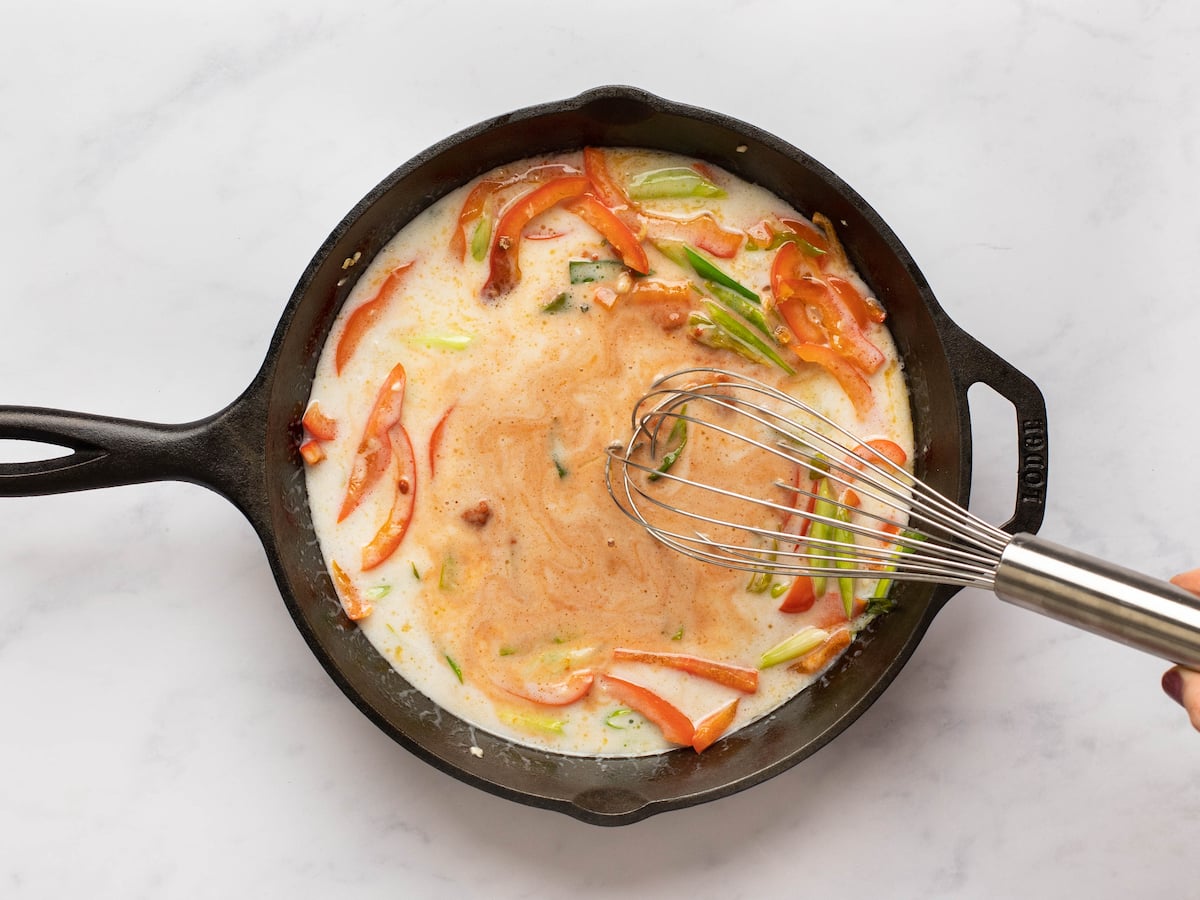
Cook the chicken: Add the chicken and simmer gently until cooked through, stirring occasionally. Don’t let the sauce boil vigorously; gentle cooking keeps the chicken tender.

Finish the curry: Stir in the lime juice, cilantro, and peanuts. Taste and add more lime if needed, then serve with jasmine rice.

Make-Ahead & Reheating Instructions
Panang curry may be made ahead of time, but take care not to overcook the chicken. After you’ve prepared the dish, let it cool down to room temperature, then transfer it to an airtight container and store it in the refrigerator. When you’re ready to enjoy it, gently reheat the curry either on the stovetop or in the microwave until it’s heated through.
Video Tutorial
Panang Curry

Ingredients
- 1½ tablespoons vegetable oil
- 1 red, orange, or yellow bell pepper, sliced
- 1 small bunch scallions, light and dark green parts, sliced diagonally into 1-in (2.5-cm) pieces
- 3 cloves garlic, minced
- 1 (14-oz) can unsweetened coconut milk (see note)
- 2½ tablespoons Thai red curry paste
- 2 tablespoons fish sauce
- 2½ tablespoons (packed) dark brown sugar
- 1¼ lb chicken breast or tenderloins, thinly sliced into bite-size pieces
- 1 tablespoon lime juice, plus lime wedges for serving (you'll need 2 limes)
- ¼ cup fresh chopped cilantro
- ⅓ cup dry roasted peanuts, finely chopped
Instructions
- Heat the oil in a large nonstick pan over medium-low heat. Add the pepper and cook, stirring frequently, until softened and starting to brown, 3 to 4 minutes.
- Add the scallions and cook, stirring frequently, until softened, 1 to 2 minutes. Add the garlic and cook, stirring constantly, for 30 seconds more; do not brown.
- Add the coconut milk, curry paste, fish sauce, and sugar and whisk together. Bring to a gentle boil, then reduce the heat to a simmer and cook, uncovered, until slightly thickened, about 2 minutes.
- Add the chicken and simmer, uncovered, stirring occasionally to promote even cooking, until the chicken is cooked through, 5 to 8 minutes. (Do not let the sauce vigorously boil; the idea is to cook the chicken gently so that it's tender.)
- Stir in the lime juice, cilantro, and peanuts. Taste and adjust seasoning with more lime, if necessary. Serve with jasmine rice.
Notes
- The consistency of canned coconut varies by brand. Some might be a bit watery, while others might separate in sauces. I’ve consistently had great results with the Thai Kitchen brand.
Pair with
Nutrition Information
This website is written and produced for informational purposes only. I am not a certified nutritionist and the nutritional data on this site has not been evaluated or approved by a nutritionist or the Food and Drug Administration. Nutritional information is offered as a courtesy and should not be construed as a guarantee. The data is calculated through an online nutritional calculator, Edamam.com. Although I do my best to provide accurate nutritional information, these figures should be considered estimates only. Varying factors such as product types or brands purchased, natural fluctuations in fresh produce, and the way ingredients are processed change the effective nutritional information in any given recipe. Furthermore, different online calculators provide different results depending on their own nutrition fact sources and algorithms. To obtain the most accurate nutritional information in a given recipe, you should calculate the nutritional information with the actual ingredients used in your recipe, using your preferred nutrition calculator.
Gluten-Free Adaptable Note
To the best of my knowledge, all of the ingredients used in this recipe are gluten-free or widely available in gluten-free versions. There is hidden gluten in many foods; if you’re following a gluten-free diet or cooking for someone with gluten allergies, always read the labels of your ingredients to verify that they are gluten-free.


I am so scared that the chicken will not be done in 5-8 minutes, I am also not a cook so I know nothing…how can I assure that the chicken will be done before I eat it? Can you pre-cook the chicken?
If you cut the chicken into bite-sized pieces and cook it for the time specified in the recipe, you can feel confident it’s cooked through, but to ensure it’s fully cooked, cut a few pieces open to check that they’re opaque and cooked to the center before serving.
I do not like to use coconut milk in my recipes as I am allergic to coconut. So, what is the substitution for coconut milk? TIA
Hi Mindy, you can replace the coconut milk with heavy cream. Keep in my end, that the coconut milk adds a distinct flavor to the dish so while this will still be good, it will definitely taste different. Hope you enjoy!
Another great dinner recipe, Jen! My husband loved it and he is extremely picky. Both teens loved it too and asked me to add it to dinner staples list. Was super easy to make, too. Thank you!
I made this tonight using lamb medallions instead of chicken. It was really good and easy. Next time I will use some chili flakes to make it a bit hotter as it is pretty mild.
As with all recipes on the internet, I always read comments. I’m frequently frustrated with things like “This looks good, I’ll have to try it!” Who cares? Make it or don’t comment otherwise it comes off like a fan club.
Gripe out of the way, I was very pleased to see most people who commented on it had actually made it and had their personal take. That is helpful! It was funny to see some people say it needed heat, some say it was too spicy. That is undoubtedly a matter of the curry paste you use since there is no other ingredient to add heat. Taste the paste FIRST, then add heat with red pepper flakes, cayenne or Sriracha. Reduce by cutting it down. A jarred item like that needs to be tested before assuming it will suit your taste.
All said, I found the balance of flavors to be solid. I did want more heat (and know that I tend to like things spicier than others). I added 1 tbsp Sriracha right before the chicken and found that just enough to be noticed and balance the sweetness, but not enough to overpower the other flavors. It also boosts the garlic flavor considerably.
Asian foods are beloved worldwide, in my opinion, because of their complex depth of sour (bright), salt, umami, sweet and hot. Finding the right balance for YOU is what takes time and practice, practice, practice!
Nice recipe to start from. Thank you. 🙂
As for the lady who asked about cast iron. Buy a 12″ immediately and make it your go-to. It will love you and you will love it. Seasoned and maintained properly, cast iron is the best non-stick ever created.
I thought the fish sauce was too strong. I won’t typically use that much in a curry, but went ahead with it – and then regretted it. I might suggest to others to add the fish sauce incrementally, starting maybe with 1/2 because it does impart a strongish flavor. I also used a combination of snow peas, green pepper, and celery as well as the green onion. Thanks Jenn!
Jenn, are the peanuts essential in this dish? My husband is VERY allergic to nuts – especially peanuts. But this sounds so good, I’d love to make it.
Nope — feel free to omit them. Enjoy!
This has become a staple. So good and can be prepared earlier and reheated. Definitely a winner. 5 Stars
This was incredible! My boyfriend said it was as good as the best one he had in Thailand! Definitely recommend
I made this for dinner last night. Authentic Thai flavor. Will make again!