


This post may contain affiliate links. Read my full disclosure policy.
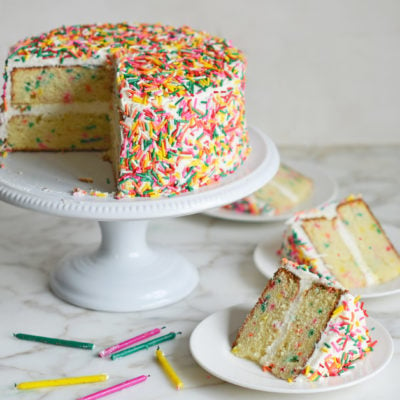
Retire the boxed version! This funfetti cake has tender vanilla layers, luscious cream cheese frosting, and enough rainbow sprinkles to make everyone smile.
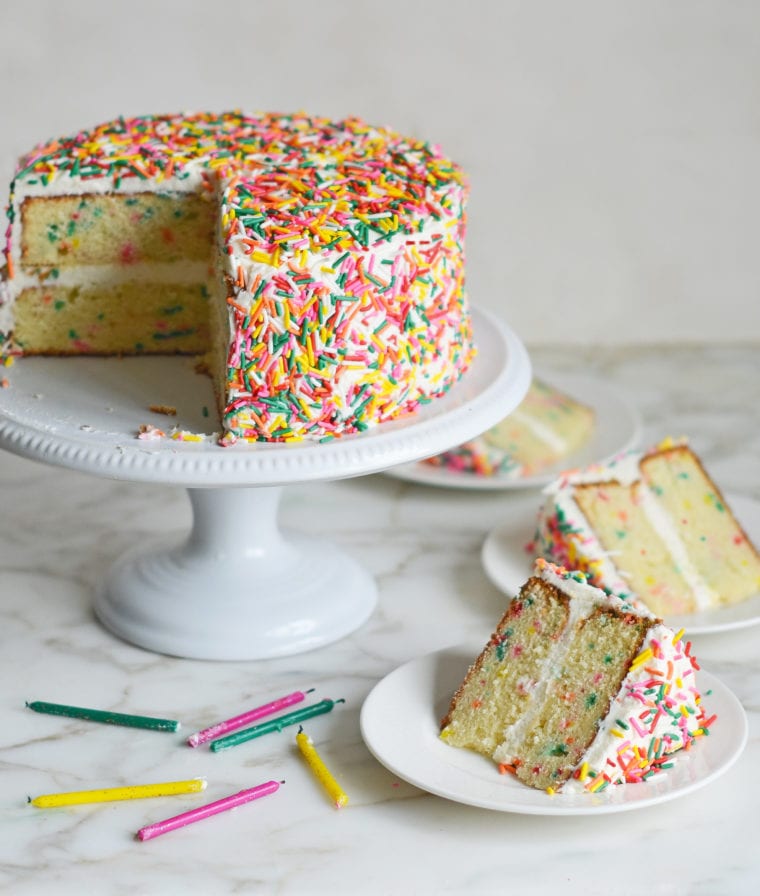
This delicious funfetti cake recipe comes from my friend Lisa Kolb Ruland. Lisa is a CIA-trained pastry chef who’s worked in New York City’s top bakeshops, and she’s the editor of Unpeeled, one of the loveliest food blogs out there.
When Lisa’s cake popped up in my inbox, my daughter insisted we make it right away. It was an instant hit. Light, tender, and packed with vanilla flavor, it’s everything a funfetti cake should be. The colorful sprinkles add a playful pop of fun, and the classic flavor appeals to kids and adults alike.
“Absolutely delicious! The best recipe I’ve used for this kind of cake.”
What You’ll Need To Make A Rainbow Sprinkle Funfetti Cake
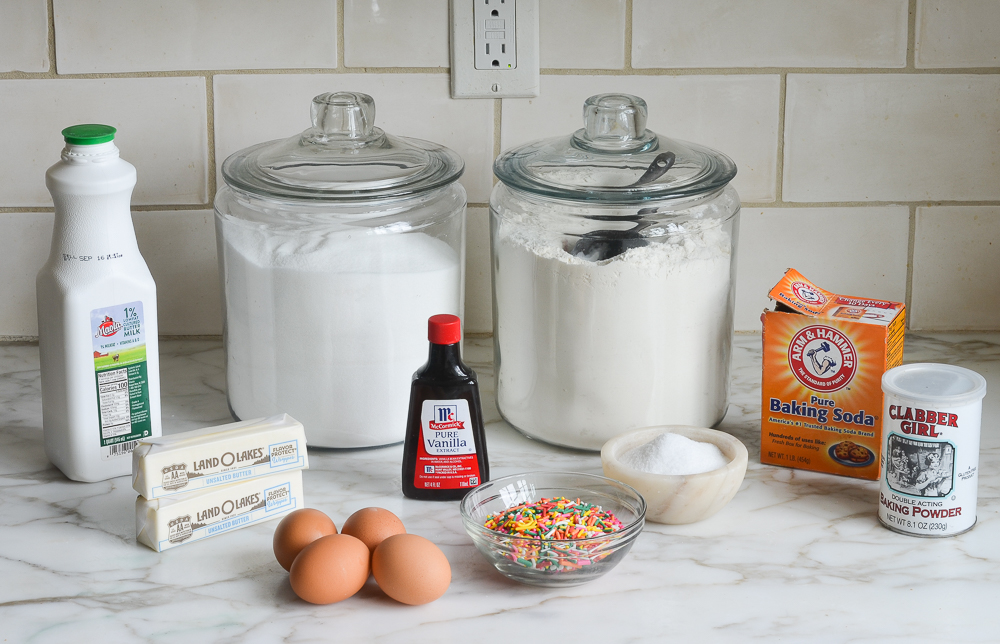
For the cake, you’ll need all-purpose flour, baking powder, baking soda, salt, unsalted butter, sugar, eggs, vanilla, buttermilk, and rainbow sprinkles.
If you’ve had sprinkles tucked away in your pantry since your last cake decorating project, make sure they’re still good—they can go bad, and if they do, they’ll taste bitter. Make sure to taste a few before you incorporate them into the batter.
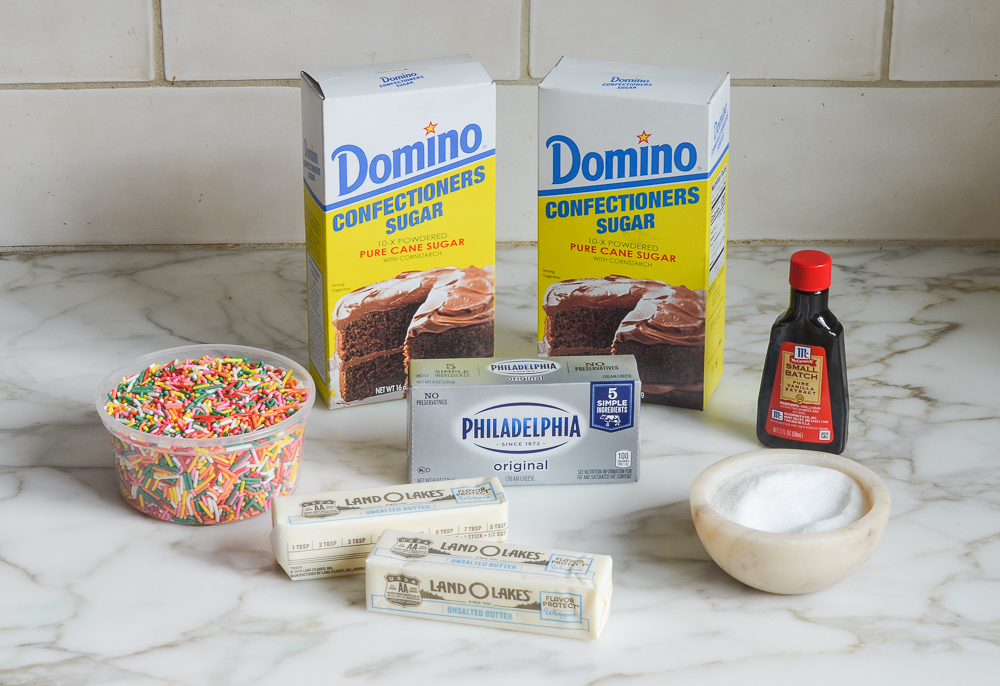
For the frosting and decoration, you’ll need unsalted butter, cream cheese, confectioners’ sugar, vanilla, salt, and rainbow sprinkles.
Step-By-Step Instructions
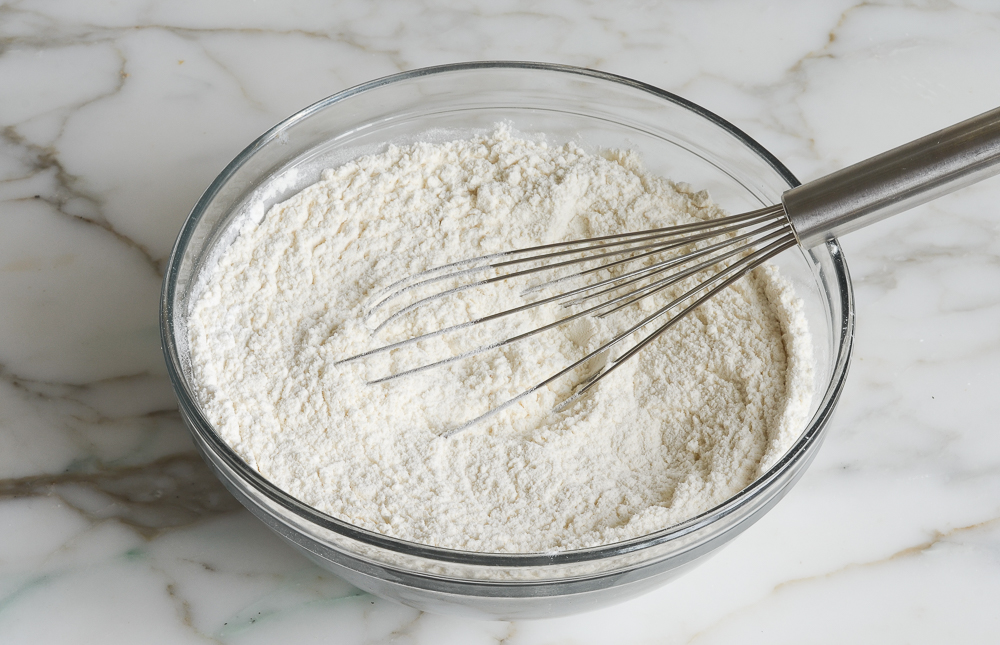
Step 1: Whisk the dry ingredients. In a medium bowl, whisk together the flour, baking powder, baking soda, and salt, then set it aside.
Step 2: Cream the butter and sugar. In a mixer fitted with the paddle attachment, cream the butter and sugar on medium speed for about 2 minutes until light and fluffy, scraping the bowl thoroughly during the process to ensure everything is evenly combined.
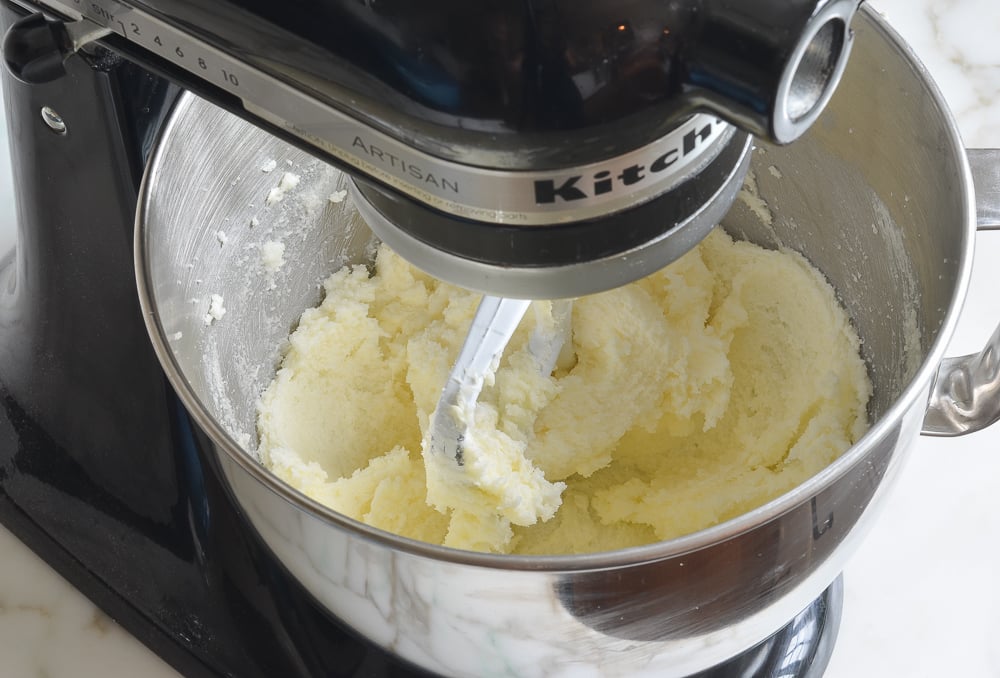
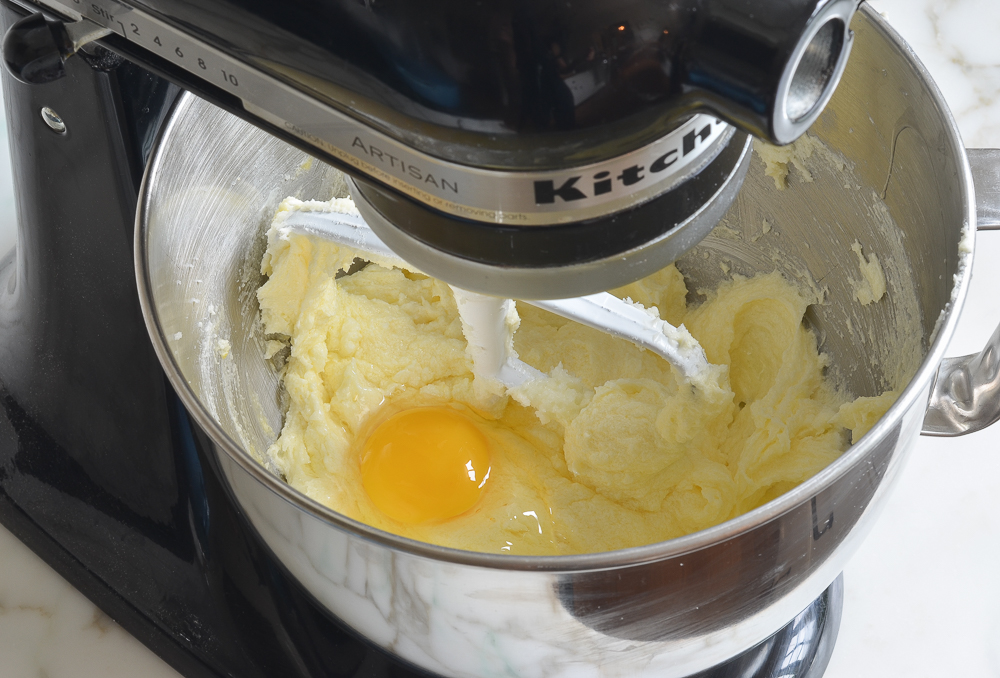
Step 3: Add the eggs and vanilla and emulsify. With the mixer on low, add the eggs one at a time, beating well after each addition (ignore any curdled appearance). Beat in the vanilla, increase the speed to medium for one minute until light and fluffy.
Pro Tip: Don’t worry if the batter looks a bit curdled—that’s totally normal. It usually happens because the cold eggs don’t easily bond with the fat in the butter. It’ll all come together and smooth out as soon as you mix in the dry ingredients.
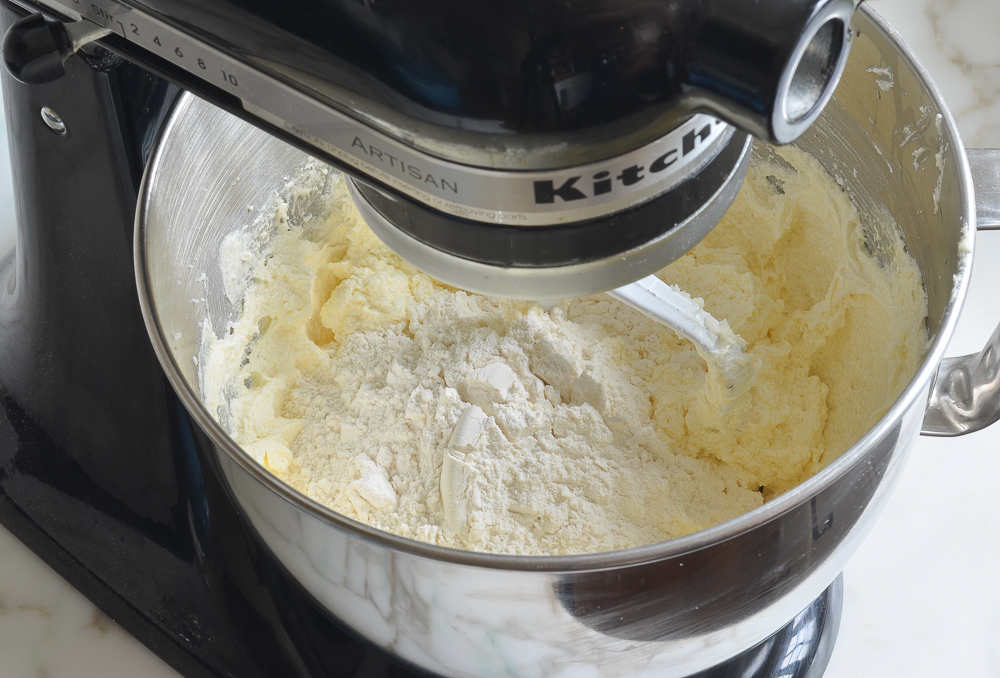
Step 4: Alternate additions. Scrape the bowl, and then on low speed, alternately add the whisked dry ingredients in three additions and the buttermilk in two: dry, wet, dry, wet, dry.
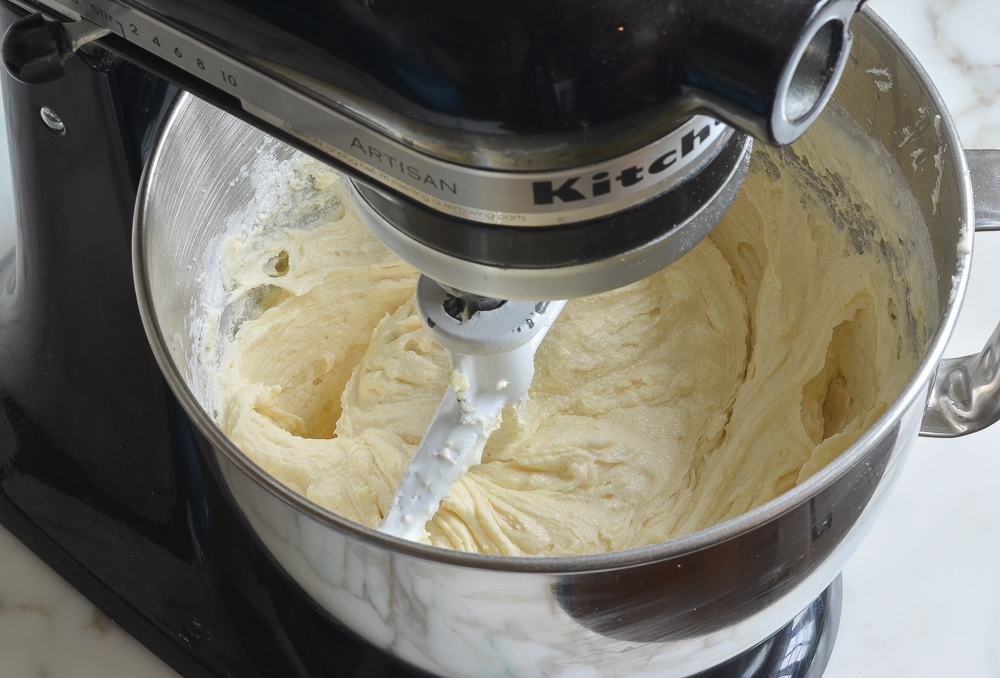
Step 5: Finish the batter. Once everything is just incorporated, remove the bowl from the mixer.
Step 6: Fold in the sprinkles and fill the pans. Scrape down the bowl as necessary, add the sprinkles, and gently fold them into the batter by hand using a spatula. Pour the batter evenly into your prepared cake pans and use the back of the spatula to smooth out the surface.
Pro Tip: Make sure you’re using classic jimmies (the long, skinny kind of sprinkles) rather than nonpareils (the tiny round little balls). Nonpareils bleed their food coloring almost as soon as they touch wet batter, which will discolor the cake.
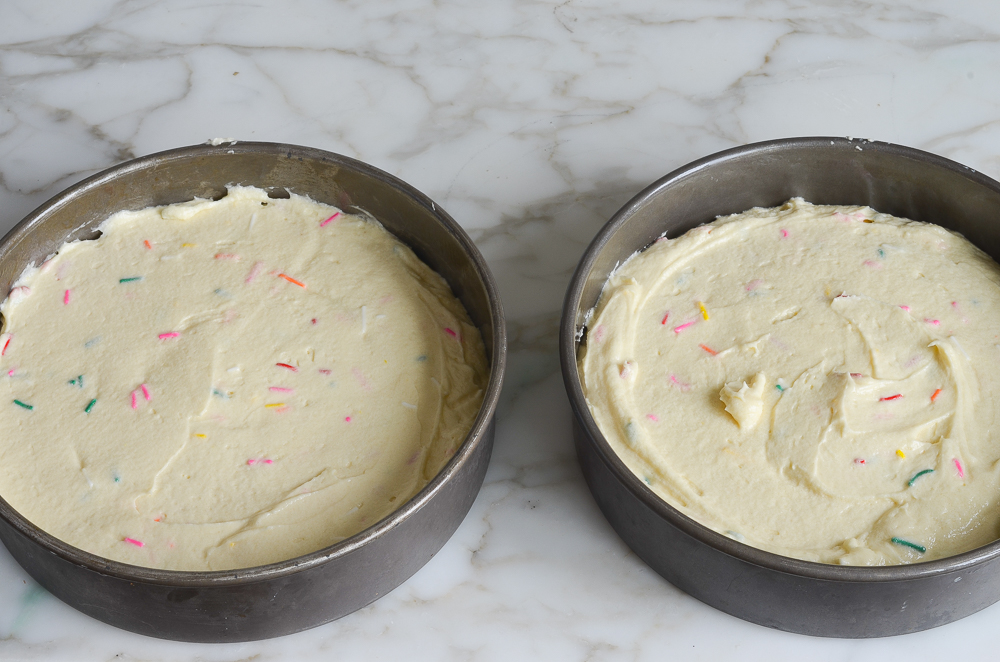
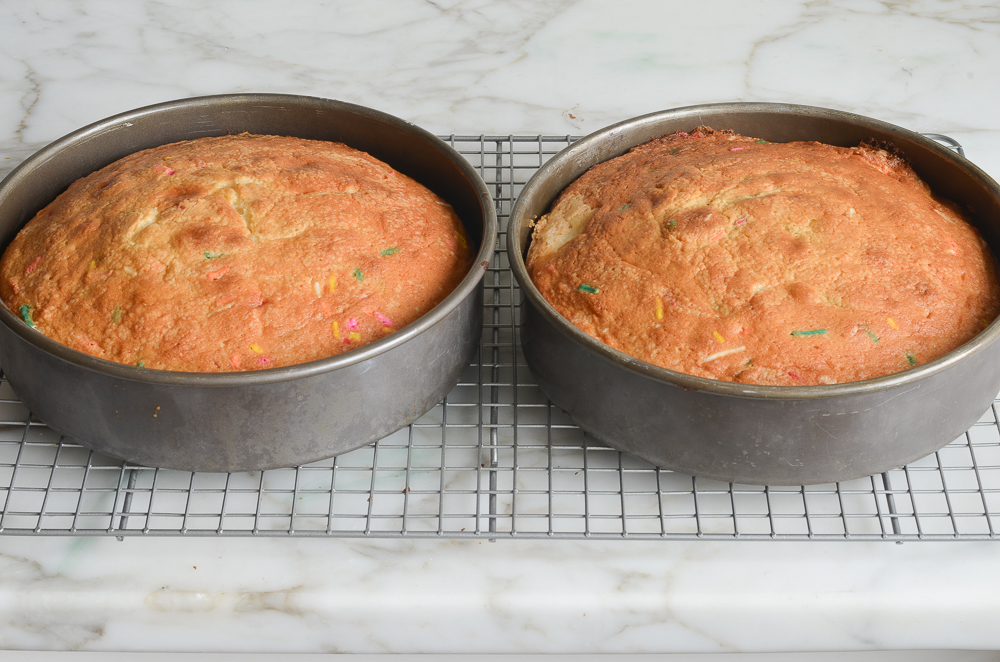
Step 7: Bake and cool. Bake for 30 to 35 minutes until golden and a tester comes out clean, then cool in the pans on a wire rack for 20 minutes before running a knife around the edges and turning the cakes out to cool completely.
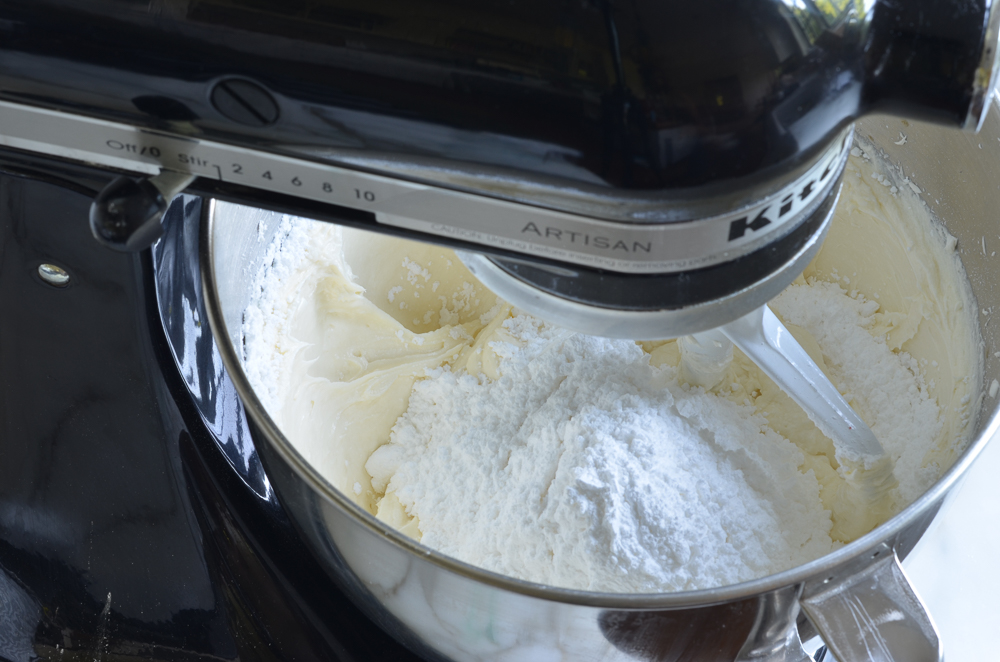
Step 8: Start the frosting. In a mixer fitted with the paddle attachment, beat the butter and cream cheese for about 30 seconds until creamy, then gradually add the confectioners’ sugar on low speed.
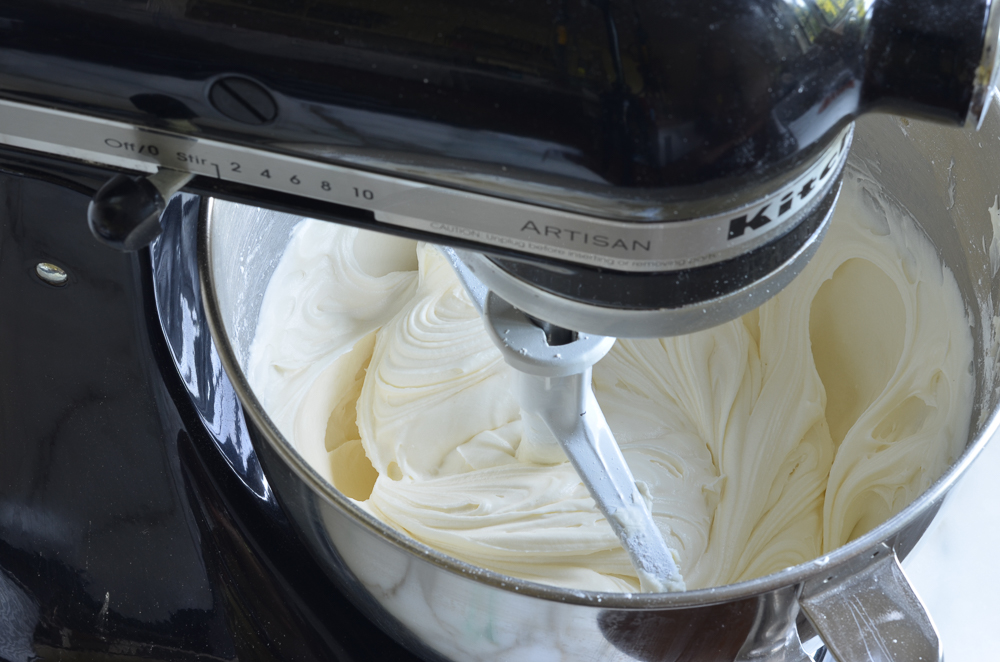
Step 9: Whip the frosting. Beat in the vanilla and salt, then increase the speed to medium-high and beat for about 1 minute until fluffy.
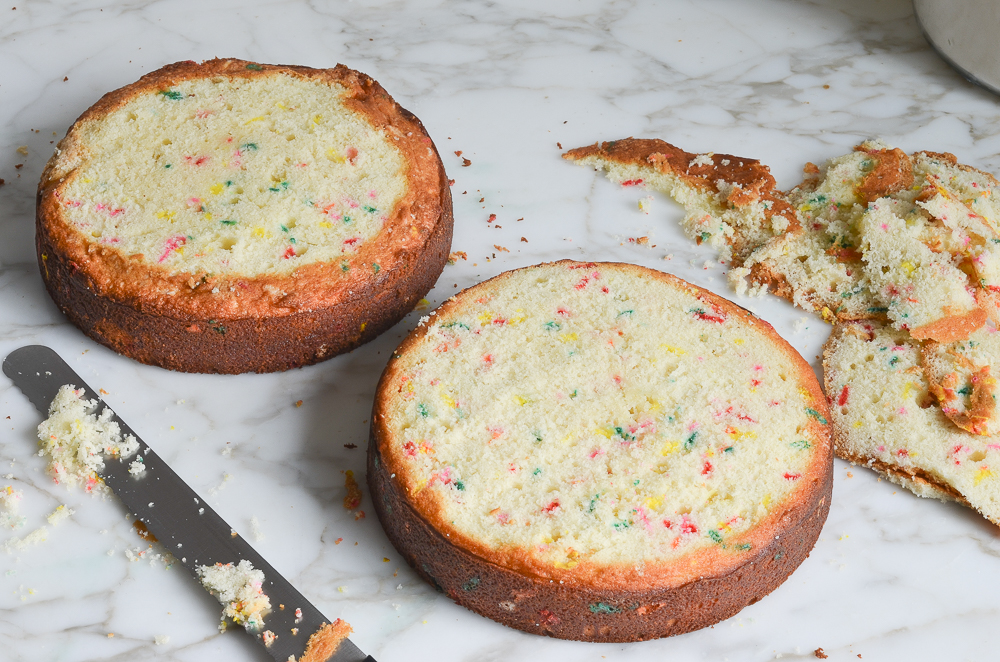
Step 10: Level the layers. Once the cake layers are cool, use a long serrated knife to cut off and discard (or snack on) the domed tops so the layers are completely flat.
Pro Tip: If you’ve got the time, pop the cooled cake layers into the freezer for about 15 to 20 minutes before you cut them. Chilling firms up the cake, making it easier to slice off those domed tops cleanly without tearing or creating too many crumbs.
Step 11: Stack and begin frosting. Place the first layer cut-side up on a stand, spread 1 cup of frosting evenly to the edge, and top with the second layer cut-side down; scoop another cup of frosting onto the center and spread it to the edge.
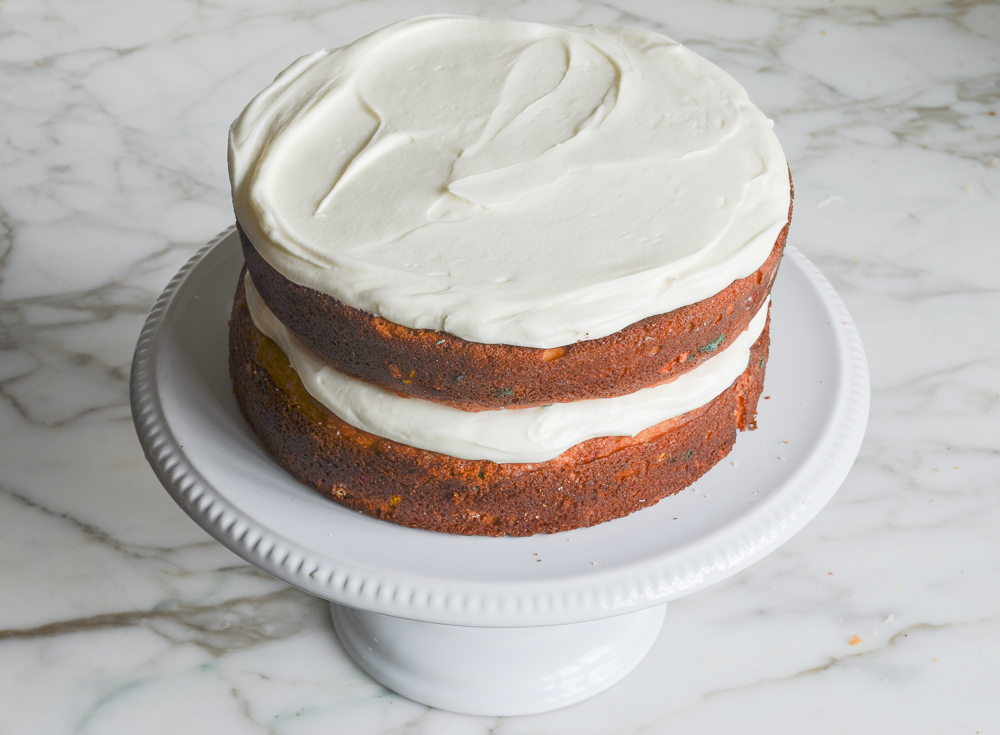
Step 12: Frost the sides and chill. Spread 1/4-cup blobs of frosting around the sides of the cake, rotating the stand until covered (don’t worry about perfection yet), then refrigerate uncovered for 15 to 30 minutes to set.
Pro Tip: What you’re doing here is called a “crumb coat”—a thin, initial layer of frosting that acts like a primer. It traps any loose cake crumbs so they don’t get mixed into your final layer of frosting. Chilling it locks everything in place, so the finish looks clean.
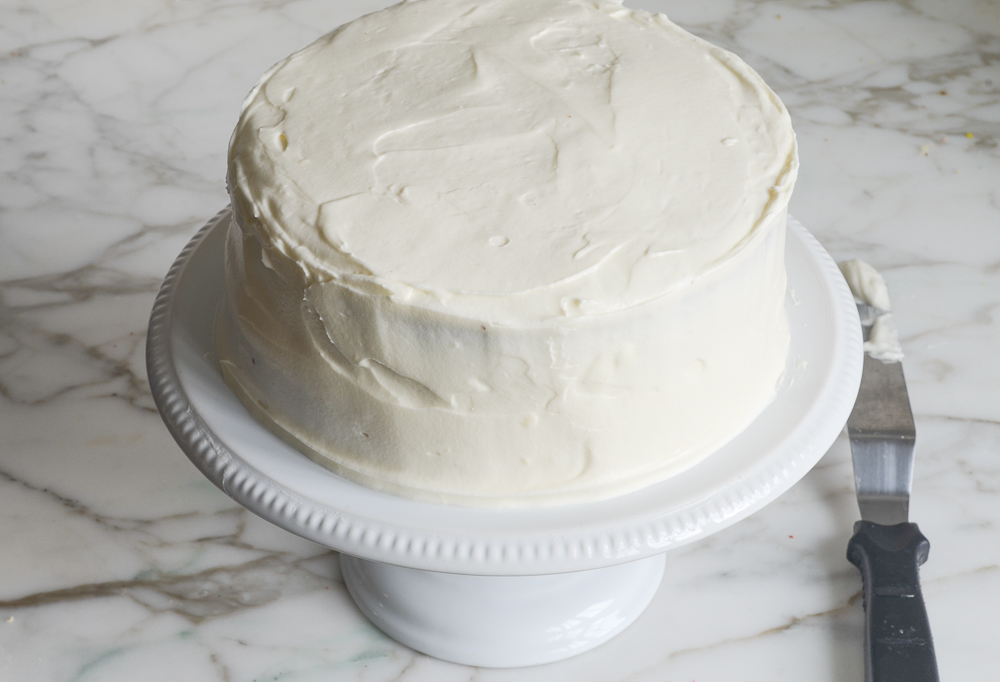
Step 13: Smooth and add side sprinkles. Remove from the fridge, run a warmed, damp offset spatula over the frosting to make it smooth and glossy, then gently press handfuls of sprinkles into the sides of the cake from the bottom up, rotating as you go.
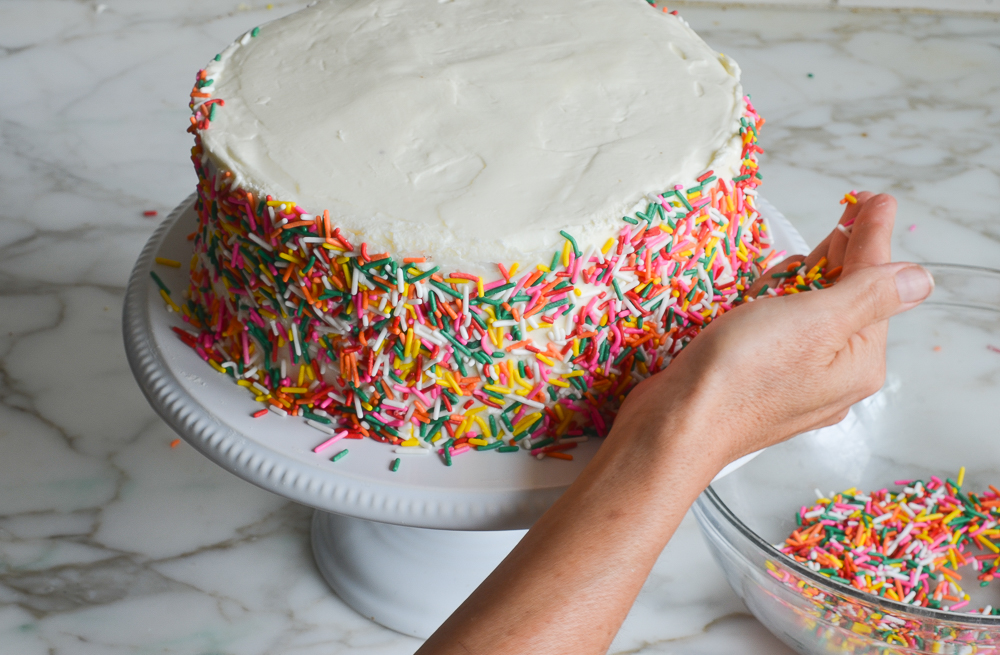
Step 14: Sprinkle the top. Gather another large handful of sprinkles and scatter them over the top of the cake, using a wide metal spatula to gently press them in and even out any remaining bumps.
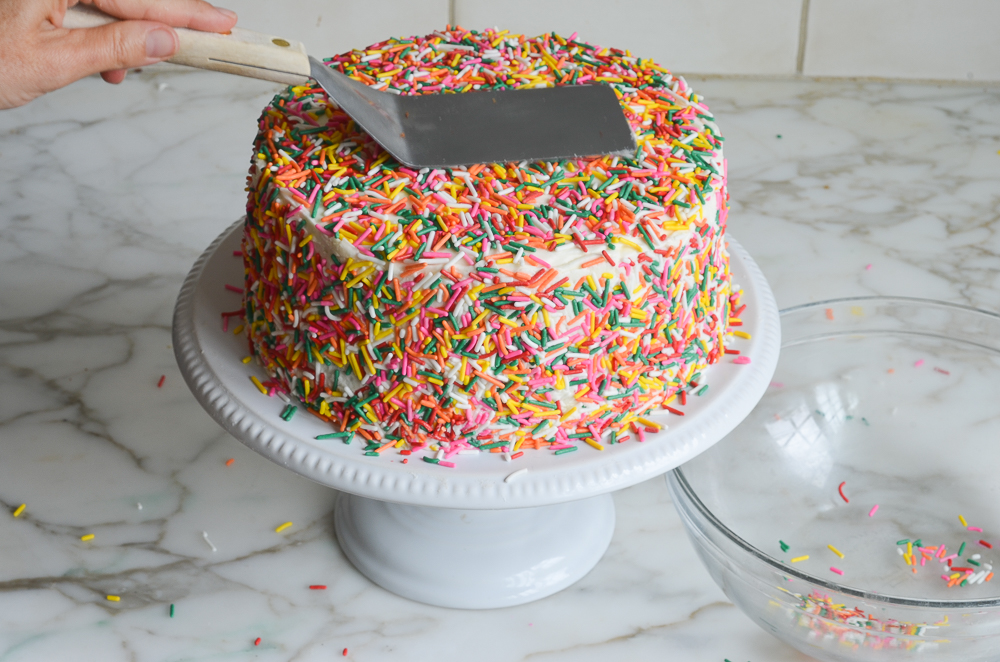
Step 15: Clean up and serve. Scrape away any fallen sprinkles from the cake stand, wipe the edges clean with a damp paper towel, then slice and celebrate. The cake (without frosting) can be baked and frozen for up to 3 months.
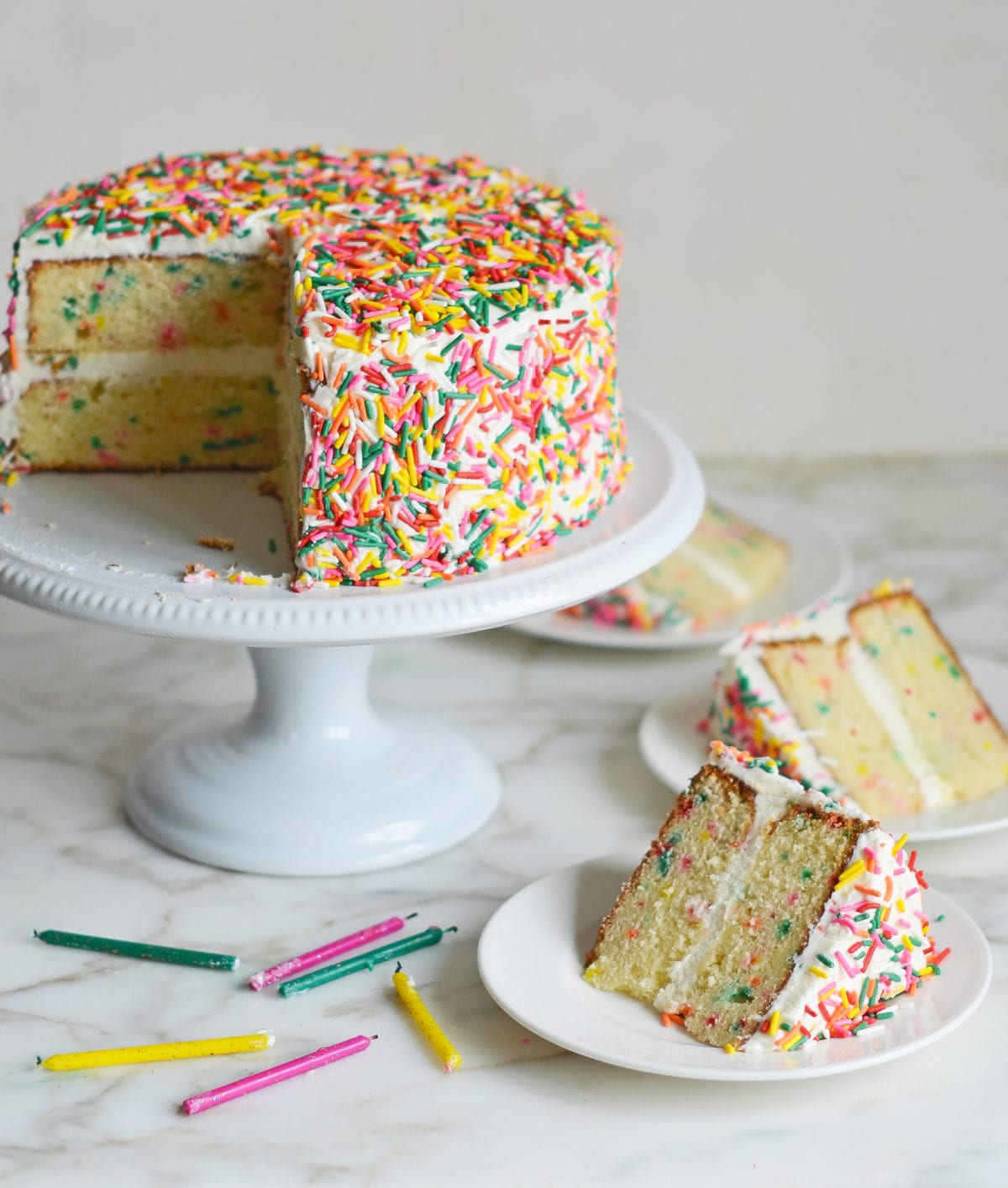
Note: I have simplified Lisa’s cake decorating method a bit here. If you’d like to see how a professional pastry chef frosts and decorates a cake, check out Lisa’s excellent tutorial here.
More Classic Cake Recipes for Birthdays and Beyond
Rainbow Sprinkle Funfetti Cake
Ingredients
For the Cake
- 3 cups all-purpose flour, spooned into measuring cup and leveled-off
- ½ teaspoon baking powder
- ½ teaspoon baking soda
- ¾ teaspoon salt
- 1 cup (2 sticks) unsalted butter, softened
- 2 cups sugar
- 4 large eggs
- 2 teaspoons vanilla extract
- 1 cup buttermilk
- ⅓ cup rainbow sprinkles
For the Frosting and Decoration
- ¾ cup (1½ sticks) unsalted butter, softened
- 4 oz cream cheese, at room temperature
- 6 cups confectioners’ sugar
- 2 teaspoons vanilla extract
- 2 generous pinches salt
- About 1½ cups rainbow sprinkles
Instructions
- Preheat the oven to 350°F (175°C) and set an oven rack in the middle position. Spray two 8-inch cake pans with nonstick cooking spray. Cut two 8-in (20-cm) rounds of parchment paper and line the bottom of each pan, then spray the paper with nonstick cooking spray. (To measure the parchment paper, just trace the bottom of the pan.)
- In a medium bowl, whisk together the flour, baking powder, baking soda, and salt. Set aside.
- In the bowl of an electric mixer fitted with the paddle attachment (or beaters), cream the butter and sugar on medium speed (or medium-high speed if using a hand-held mixer) until light and fluffy, about 2 minutes. Scrape the bowl once during this process to make sure everything is evenly combined. Scrape the sides of the bowl again.
- With the mixer on low, add the eggs one at a time, beating well after each addition. Don’t worry if the batter looks curdled at any point during the mixing process. Mix in the vanilla, then increase the speed to medium (or medium-high if using a hand-held mixer) and beat until the mixture is light and fluffy, about one minute. Scrape the bowl and briefly mix again.
- On low speed, alternately add the whisked dry ingredients in three additions and the buttermilk in two: dry, wet, dry, wet, dry. When everything is just incorporated, remove the bowl from the mixer. Scrape the bowl as necessary, and fold in the sprinkles by hand using a spatula.
- Pour the batter evenly into the cake pans and use the back of the spatula to smooth the batter and bake for 30 to 35 minutes, or until the cakes are golden and set, a cake tester inserted into the middle comes out clean, and the edges are pulling away from the pan. Cool the cakes in the pans on a rack for about 20 minutes. When the pans are cool enough to handle, run an offset spatula or a knife around the rim, and turn the cakes out onto the rack. Let fully cool.
- Once the cake layers are cool, use a long serrated knife to cut off the domed top of the cake layers so that they are flat. Discard (or snack on) the domed top. Repeat with the additional layer, and set aside.
- Put one cake layer on a cake stand or serving platter with the cut-side up. Put about 1 cup of the frosting in the center and, using the the back of an offset spatula (or a butter knife, if you don’t have an offset spatula), spread the frosting evenly just to the edge of the cake. Add the second cake layer on top of the first, so that the cut-side is down (and the bottom of the cake is on top). Scoop about 1 cup of the frosting onto the center of the cake and spread it to the edge. Get eye level with the cake to make sure that everything looks even. Put a ¼-cup blob of frosting on the side of the cake, and use your offset spatula to spread it over a section of cake. Rotate the cake stand as you go. Repeat until the entire side of the cake is covered fully. Don’t worry about making the frosting too perfect; you will smooth it out again later, and the sprinkles will cover any imperfections.
- Place the cake, uncovered, in the refrigerator for 15 to 30 minutes to set.
- Remove the cake from the refrigerator. If you touch the frosting, you will notice that it has formed a skin; that’s normal. Place the cake next to the sink and turn on the hot water. Hold an offset spatula (or butter knife, if you don’t have an offset spatula) under the hot water for a few seconds to warm it. Tap off any excess water, and then slowly run the hot spatula over an area of frosting until it is smooth and glossy. Continue this process over the entire cake, warming the spatula under hot water as necessary, until the cake is smooth and glossy all over. This process both evens out any bumps in the frosting and also creates a “sticky” surface for the sprinkles to adhere.
- Place the cake stand on a 13 x 18-in (33 x 46-cm) sheet pan. This will catch the falling sprinkles. Fill a small bowl with about the sprinkles. Gather a handful of sprinkles in your palm and gently press them into the side of the cake, working from the base of the cake to the top edge, opening your palm as you go. Stop at the edge and don’t “round the corner” onto the top of the cake. You want to keep those side edges sharp. Rotate the cake stand in your hand and repeat, going all the way around. Gather another large handful of sprinkles and sprinkle them over the top of the cake. (I like to use a wide metal spatula to gently press the sprinkles into the frosting to even out any remaining bumps.) Scrape any "fallen" sprinkles off the cake stand and wipe the edges of the cake stand clean with a damp paper towel, if necessary.
For the Frosting
- In the bowl of an electric mixer fitted with the paddle attachment (or beaters), beat the butter and cream cheese until creamy and evenly combined, about 30 seconds. With the mixer on low speed, gradually add the confectioners’ sugar until incorporated, then beat in the vanilla and salt. Increase the speed to medium-high (or high speed if using a hand-held mixer) and beat until fluffy, about 1 minute.
Notes
Nutrition Information
This website is written and produced for informational purposes only. I am not a certified nutritionist and the nutritional data on this site has not been evaluated or approved by a nutritionist or the Food and Drug Administration. Nutritional information is offered as a courtesy and should not be construed as a guarantee. The data is calculated through an online nutritional calculator, Edamam.com. Although I do my best to provide accurate nutritional information, these figures should be considered estimates only. Varying factors such as product types or brands purchased, natural fluctuations in fresh produce, and the way ingredients are processed change the effective nutritional information in any given recipe. Furthermore, different online calculators provide different results depending on their own nutrition fact sources and algorithms. To obtain the most accurate nutritional information in a given recipe, you should calculate the nutritional information with the actual ingredients used in your recipe, using your preferred nutrition calculator.
How much fun it was to make this beautiful showstopper cake! So colorful and moist and delicious too! A family favorite,! Will be baking this for special occasions for years to come! Love it.
I LOVED making this cake. It came out so perfect. I cannot wait to make it again…I don’t know that I can’t wait for another special occasion like a birthday 😅
I made this cake for a friend’s birthday and it was just what we needed during this weird time, when celebrations feel so different. We all felt happy and festive just looking at this beautiful cake, and even happier as we ate it! Thanks for the great recipe and the endless inspiration!
Hi Jenn! I plan to make this cake today. Do the eggs need to be room temperature? Thank you so much! I have really been enjoying so many of your recipes!
Hi Danielle, This isn’t one of those recipes where it makes a big difference, but it’s always best if eggs are room temperature when baking. Hope you enjoy!
My frosting also came out really hard. I make a ton of your recipes and generally find they turn out great so I am not sure what happened here. I measured correctly (although 6 cups of icing sugar did seem like a lot to me for the amount of butter and cream cheese). It tasted delicious but was just very very thick and almost impossible to spread. Any suggestions as to how to thin icing out if that happens again? Could I have added milk?
Hi Jane, the consistency of the frosting can vary a lot based on the temperature of the butter and cream cheese. If necessary, it’s fine to thin it with 1 – 2 tablespoons of milk or cream. Hope that helps!
My frosting came out hard and it was not easy to spread. I was careful to have the butter and cream crease at room temperature. Even after frosting, my cake does not look anything like yours in your pictures – very smooth. Where, do you reckon, I could have gone wrong
It is in the fridge now. I hope the second stage of smoothing it, it will look good.
Hi Sarah, Is there any chance you may have made a measuring error? If it was too thick/hard, I’m wondering if perhaps you added an additional cup of confectioners’ sugar.
Finally I’ve redeemed myself! Every year for his birthday my son asks for vanilla cake with vanilla icing. I’m a decent baker but for the life of me I struggle with vanilla cake. It’s always dry or flavourless to the point where I’ve resorted to boxed mixes, ice cream cake or donuts. I nailed it this year for his 16th! It is not delicate but somewhat dense, with the consistency between tender and that of a pound cake. I used organic cane sugar. Maybe the cake was more dense because those crystals are bigger than that of granulated sugar?? I also used a full vanilla bean rather than extract and the flavour gets even better the next day. The cake was a hit with everyone:):):)
Hi Jenn,
I have made about a dozen of your recipes over the last few months and have found some really great staples that I’ve been throwing into my rotation. Thank you for such a great site with easy instructions and ingredients!
I’m planning to make this cake for my son’s second birthday. I was wondering whether I could make it a four layer cake instead of two (I’m dying the layers jewel tones for an Aladdin themed Halloween Birthday celebration). Any tips would be greatly appreciated regarding baking times or amounts (if you think the layers would be too scant if I divide the batter into four or if I’ll need more frosting). Thanks!
Best,
Safa
Hi Safa, so glad you like the recipes! I think that the layers would be too thin if you divided the batter into four cake pans. Rather, I’d bake the cake as instructed and then slice the two layers in half horizontally to make 4 layers. And you will need more frosting; I’d make one and a half times the recipe. Sounds like a great birthday cake!
What depth would u say the 8inch cake tins need to be as I have 2 8″ cake tins and I’d say they are about 4inch in depth
Hi Holly, Hi Holly, most cake tins are about 2 inches deep, so you’ll have more than enough room. Enjoy!
Hi Jenn!
Would I be able to decrease the amount of sugar, without affecting the taste/ consistency of the cake? Also, I’m a huge fan of all your recipes!! I’ve shared your website with so many of my friends!
Thanks so much,
Roshnee
Glad you like the recipes! You could get away with cutting the sugar by 1/4 to 1/2 cup here. Please LMK how it turns out!
Thanks so much Jenn!!
I will let you know🤗
Roshnee
Hi! I don’t have a stand mixer. Could I use a handheld one instead? And if so, should I modify anything? Thanks!!
Sure, just increase the speed a bit. Hope you enjoy!
Have you made this cake with yogurt as a substitute for the buttermilk?
thank you!
No, but I think you could; you may just need to thin it out a bit with a little milk. Please LMK how it turns out if you try it!