

This post may contain affiliate links. Read my full disclosure policy.
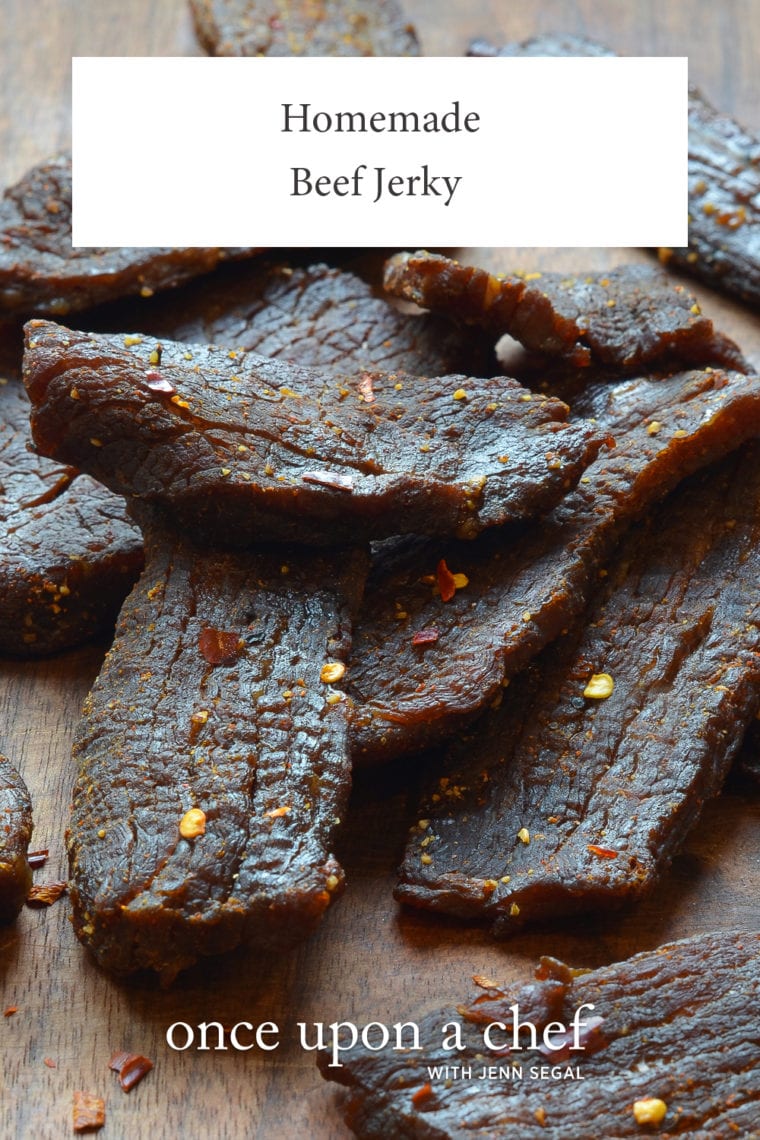
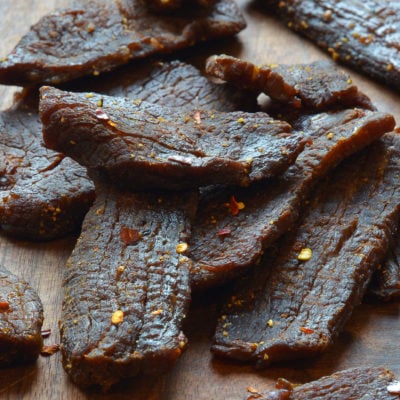
This is the best homemade beef jerky recipe, and it’s easy to make without any special equipment.
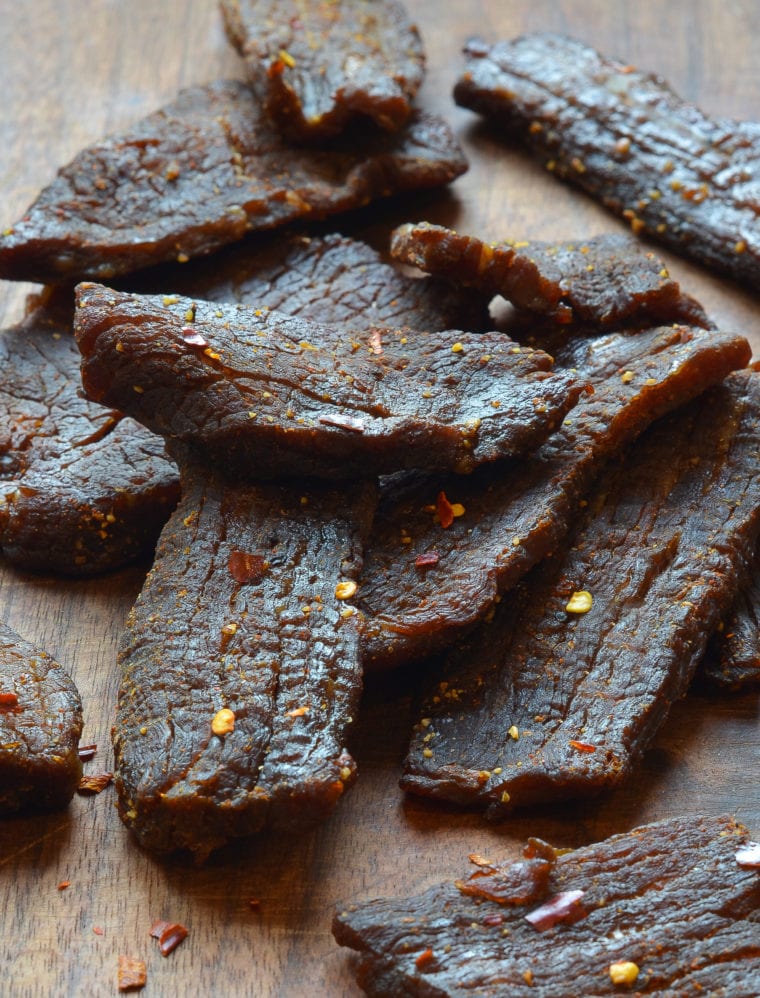
After road tripping with my family and sampling jerky from gas stations along the way — and spending a small fortune on it — I resolved to come up with a good homemade beef jerky recipe. The good news is that beef jerky is surprisingly easy to make and doesn’t require any special equipment other than a standard oven, baking sheets, and wire racks. However, most homemade jerky isn’t nearly as tender as the store-bought kind. That’s because commercial jerky producers use special equipment and curing preservatives to make their signature jerky.
Finally, after falling down an internet rabbit hole of pitmaster video tutorials, I learned the secret to making tender jerky at home: adding plenty of sugar to the marinade. The extra sugar not only helps preserve the meat but also locks in moisture. This recipe makes a salty-sweet, smoky jerky with a chewy yet tender texture, similar to the well-known brands.
What You’ll Need To Make Homemade Beef Jerky
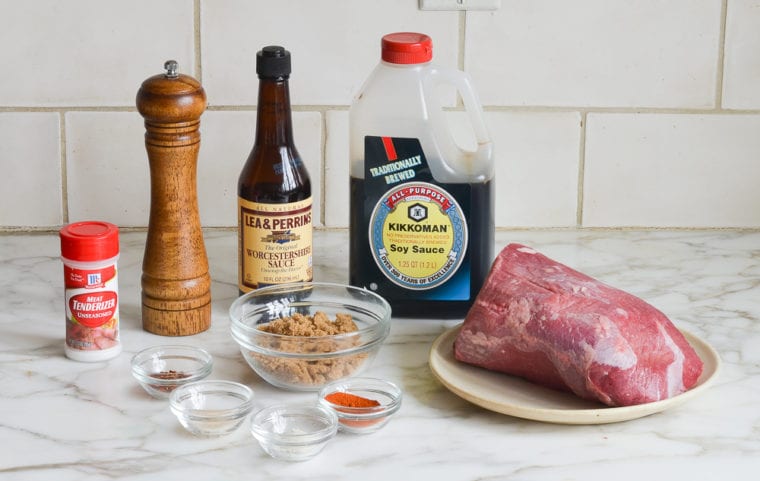
When making beef jerky, it’s important to start with a well-trimmed, lean cut of meat, as fat does not dry out and accelerates spoilage. An eye of round roast is ideal; it’s affordable, accessible, lean, and easy to trim. Before slicing, pop it in the freezer for 1 to 2 hours; it will be much easier to cut.
The marinade contains soy sauce, brown sugar, Worcestershire sauce, seasoning, and unseasoned meat tenderizer. Meat tenderizer contains bromelain, an enzyme that breaks down meat tissue. You can find it in the spice section of your supermarket (I use McCormick).
Step-by-Step Instructions
Step 1: Slice the Meat
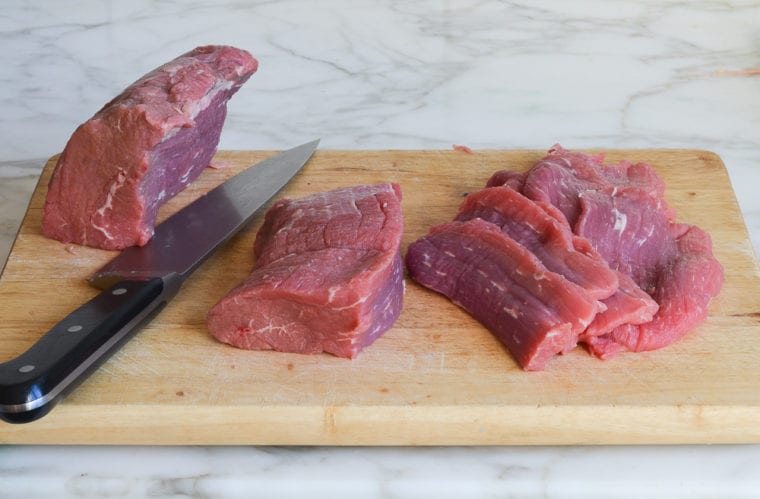
Slice the meat between 1/8 and 1/4 inch thick with the grain. If the roast is too thick to slice easily, cut it in half horizontally before slicing.
Step 2: Make the Marinade
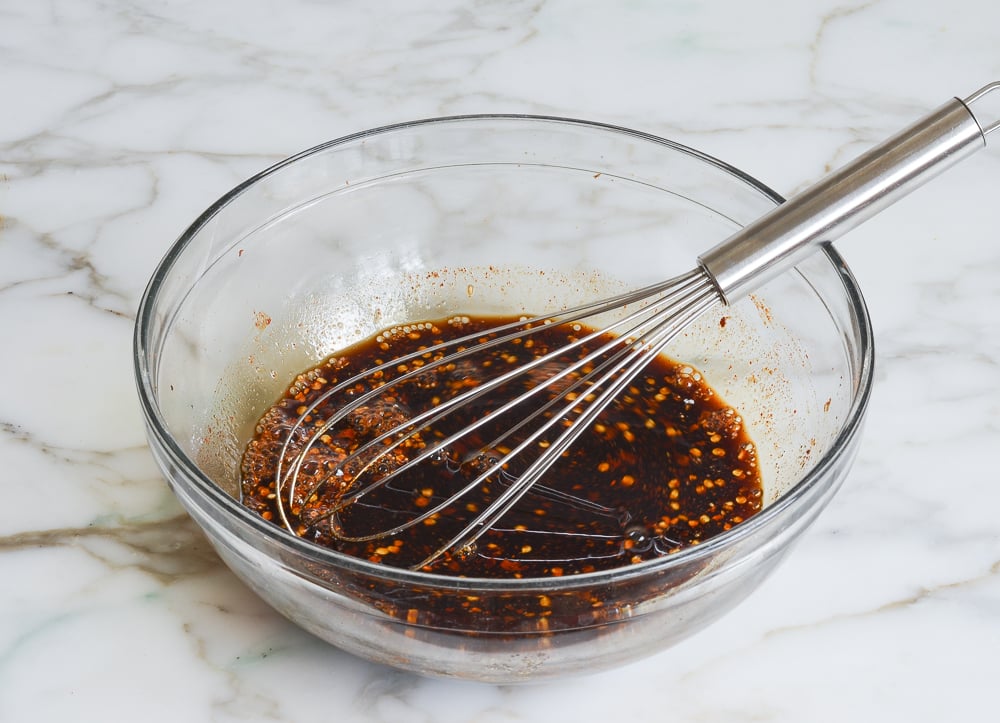
In a medium bowl, combine the brown sugar, soy sauce, Worcestershire sauce, smoked paprika, meat tenderizer, black pepper, red pepper flakes, onion powder, and garlic powder. Whisk until evenly combined and the sugar is dissolved.
Step 3: Marinate the Beef
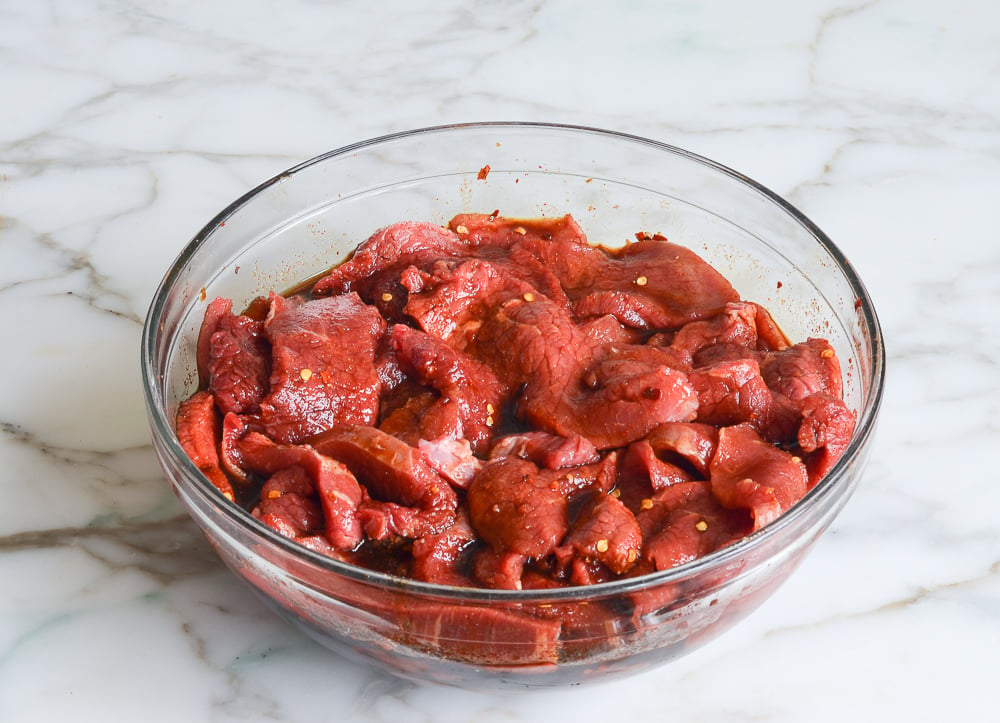
Add the meat to the marinade and toss until all of the pieces are evenly coated. Cover with plastic wrap (or transfer to a large ziplock bag) and marinate in the refrigerator for at least 12 hours or overnight. Toss the meat (or flip the bag) once or twice to be sure the meat marinates evenly.
Step 4: Dry Out The Meat
Line two baking sheets with aluminum foil for easy clean-up. Place a wire rack over each pan. Preheat the oven to 175°F and set two oven racks in the centermost positions.
Arrange the marinated meat on the wire racks in a single layer.
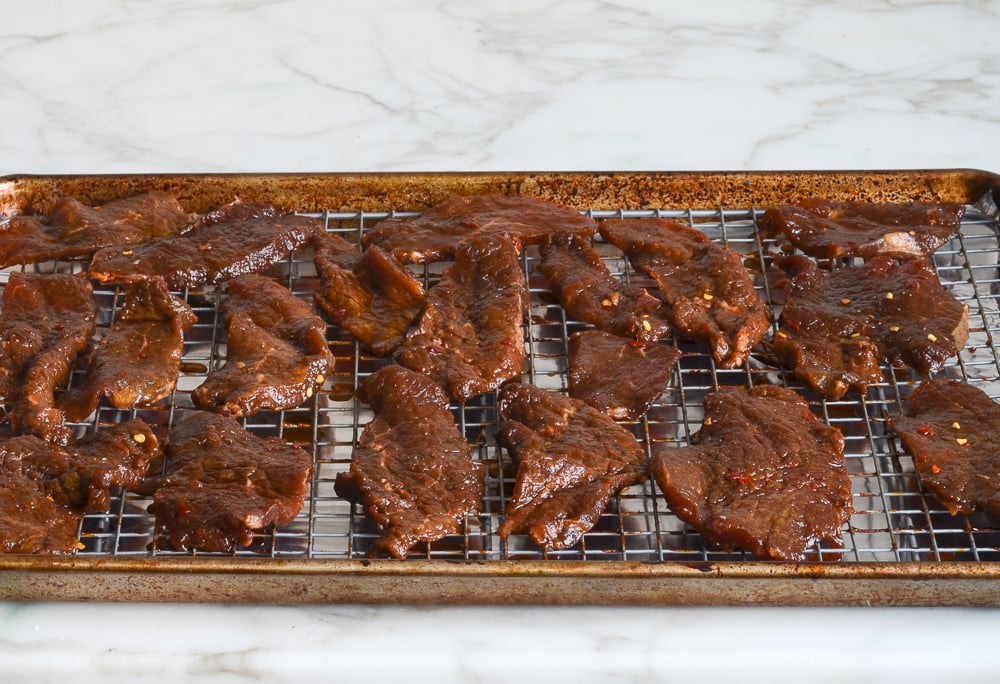
Bake, rotating the pans from front to back and top to bottom midway through, until the meat is dried out, 3 to 4 hours. To determine if the jerky is thoroughly dried out, take a piece out of the oven and let it cool to room temperature. It should be dry to the touch, leather-like in appearance, and chewy but still somewhat tender.
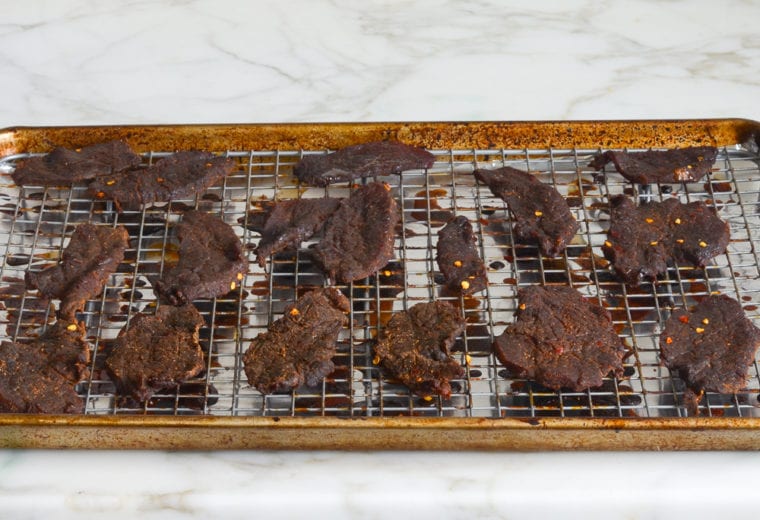
Store the jerky inside an airtight plastic container, Ziploc bag, or airtight glass jars. Properly dried jerky will keep at room temperature for about one week.
video tutorial

You May Also Like


The Best Homemade Beef Jerky Recipe
Ingredients
- 1 (3-lb) eye of round roast (see note), trimmed of fat and silver skin
- 1 cup (packed) dark brown sugar
- 1 cup soy sauce
- 3 tablespoons Worcestershire sauce
- 1 tablespoon smoked paprika
- 1 teaspoon unseasoned meat tenderizer (see note)
- 1 teaspoon freshly ground black pepper
- 1 teaspoon crushed red pepper flakes
- 1 teaspoon onion powder
- ½ teaspoon garlic powder
Instructions
- Slice the meat between ⅛ and ¼ in (3 and 6 mm) thick with the grain. (If the roast is too thick to slice easily, cut it in half horizontally before slicing.)
- Make the marinade: In a medium bowl, combine the brown sugar, soy sauce, Worcestershire sauce, smoked paprika, meat tenderizer, black pepper, red pepper flakes, onion powder, and garlic powder. Whisk until evenly combined and the sugar is dissolved.
- Add the meat to the marinade and toss until all of the pieces are evenly coated. Cover with plastic wrap or transfer to a large ziplock bag and marinate in the refrigerator for at least 12 hours or overnight. Toss the meat (or flip the bag) once or twice to be sure the meat marinates evenly.
- Line two baking sheets with aluminum foil for easy clean-up. Place a wire rack over each pan. Preheat the oven to 175°F (79°C) and set two oven racks in the centermost positions.
- Arrange the marinated meat on the wire racks in a single layer. Bake, rotating the pans from front to back and top to bottom midway through, until the meat is dried out, 3 to 4 hours. To determine if the jerky is thoroughly dried out, take a piece out of the oven and let it cool to room temperature. It should be dry to the touch, leather-like in appearance, and chewy but still somewhat tender.
- Store the jerky inside an airtight plastic container, Ziploc bag, or airtight glass jars. Properly dried jerky will keep at room temperature for about one week. Refrigerate or freeze for longer storage.
Notes
- Pop the meat in the freezer for 1 to 2 hours before slicing; it will be easier to cut.
- Meat tenderizer contains bromelain, an enzyme that breaks down meat tissue. You can find it in the spice section of your supermarket. (I use McCormick.)
This website is written and produced for informational purposes only. I am not a certified nutritionist and the nutritional data on this site has not been evaluated or approved by a nutritionist or the Food and Drug Administration. Nutritional information is offered as a courtesy and should not be construed as a guarantee. The data is calculated through an online nutritional calculator, Edamam.com. Although I do my best to provide accurate nutritional information, these figures should be considered estimates only. Varying factors such as product types or brands purchased, natural fluctuations in fresh produce, and the way ingredients are processed change the effective nutritional information in any given recipe. Furthermore, different online calculators provide different results depending on their own nutrition fact sources and algorithms. To obtain the most accurate nutritional information in a given recipe, you should calculate the nutritional information with the actual ingredients used in your recipe, using your preferred nutrition calculator.
Per my comment yesterday. I followed the recipe. To me the beef jerky tastes really salty. Any suggestions to eliminate that salty taste? Perhaps more brown sugar? Any suggestion would be appreciated. By the way, thank you for posting this recipe. I just have to tweak it a bit to satisfy my taste.
Hi Paul, Sorry you found the jerky too salty! If you make it again, you could try using all low-sodium soy sauce (or half regular and half low-sodium).
Hello,
Everything is fine with the recipe, but why the meat is getting wet, on the second day? Any tips for storage? Thank you.
Hi Modestas, the jerky may have turned moist on the second day due to incomplete drying, where residual moisture remained in the meat, or improper storage, which allowed the jerky to reabsorb moisture from the air. Additionally, packaging the jerky before it cooled completely could have caused condensation inside the container, leading to moisture buildup.
I will try that. Thanks for the response.
I feel a little disappointed that I didn’t read the reviews prior to making this. The London Broil is now marinating in the refrigerator, so I don’t want to alter the ingredients, but I’m hoping that it doesn’t turn out too sweet. I will dehydrate the product tomorrow and will let you know my thoughts of the end product.
If you aren’t a fan of sweet beef jerky like myself, either omit the brown sugar or find another recipe. It was WAY too sweet for my taste.
How long should the beef strips be?
Hi Kurt, It really depends on how large the piece of beef. (If it’s too thick to slice easily, you can cut it in half horizontally before slicing.) Even if you don’t need to cut it in half but the slices are long, you can cut them to your liking.
I’ve never made any jerky but I’m going to use this recipe as my first attempt! If I’m using my ninja air fryer on the dehydrator setting do you know what temperature and how long I should do? I’ve never used that setting so I’m not sure.
Surprisingly, I found that the jerky turned out much better (and more tender) when made in the oven as opposed to the dehydrator, so I’d recommend sticking with the oven. If you feel strongly about using your dehydrator, I’d set it to 165 degrees for 4 hours. Please LMK how it turns out!
Outstanding results! Doubled it and made about 6 pounds of jersey with eye of round. So very good.
Just made jerky in my new dehydrator using this recipe and it came out so good. Sliced the meat really thin, marinated over night and the flavor is amazing! My first time making jerky and it’s a hit with my family. Thanks for a great and easy recipe Jen!
Hi Debbie, How long did you leave it in your dehydrator. I wanted to use my new one too.
This is really just a question. Does anybody know when/where the idea of adding sugar to beef jerky come about? We used to live in Detroit, and in the 1970s, whenever we went up north on vacation, there was a grocery store in Rose City MI where we’d stop and load up for the season. Nobody we asked ever suggested adding sugar. It just wasn’t done.
Eventually we figured out how to make it ourselves, but once we relocated to AZ in 1986, we never saw a jerky that wasn’t loaded with sugar. We still make our own, of course, just because you can’t buy jerky anywhere that doesn’t have sugar. We thought it was an AZ thing, but friends back in MI are also making their own now b/c they can’t find any without sugar, either.
Thanks!
Hi Trudy, this recipe is truly great. We’re on third batch; each time modifying slightly to suit our tastes. In attempt to watch our sugar levels we did not add extra sugar to this batch; relying on the natural sweetness of the pineapple juice. We also added an extra bit of heat this “go around”. No one is missing the sugar; loving the added heat. Maybe give the recipe a try and see how you might want to modify it for you and your family. We found the recipe very easy and friendly to some variation.
Luckily my parents thought the same. I regret using this recipe because I simply do not like sweet beef jerky. It tastes too much like teriyaki.
This is so good! I’m marinating my third batch now. I don’t think I could buy commercially made ever again.
Jenn, thx so much for a great, fool proof, jerky recipe. Made first batch exactly as you shared and it was super good. In fact, the process and method have given flight to my confidence and I ventured forth with a second batch delving into my own iteration. Jenn’s recipe is easily adaptable to personal tastes and the method is replicable with other “tastes”. Thank you.