


This post may contain affiliate links. Read my full disclosure policy.
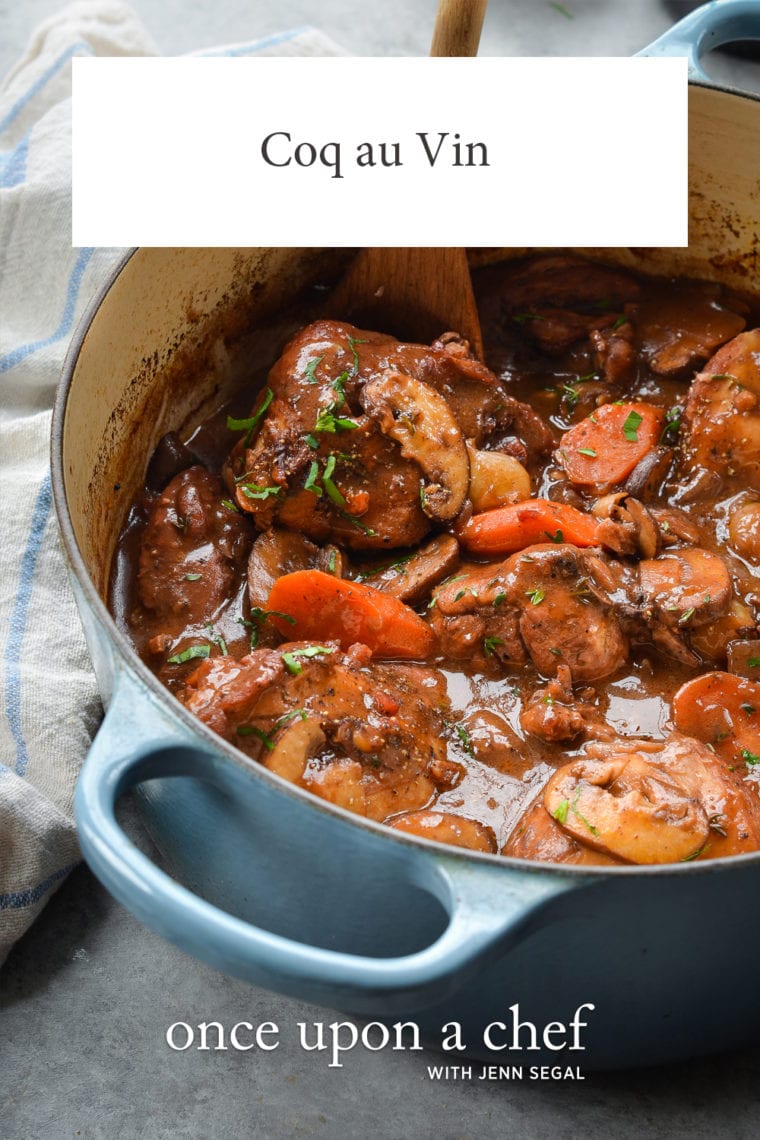
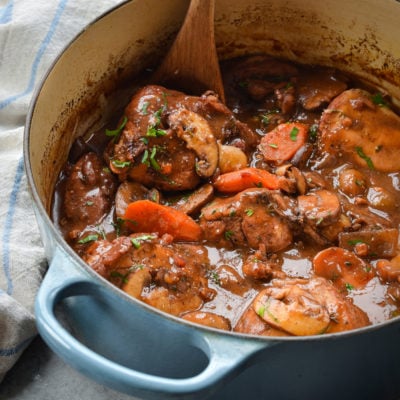
This coq au vin recipe pairs tender chicken with mushrooms and pancetta in a rich red wine sauce—it’s French comfort food at its best.
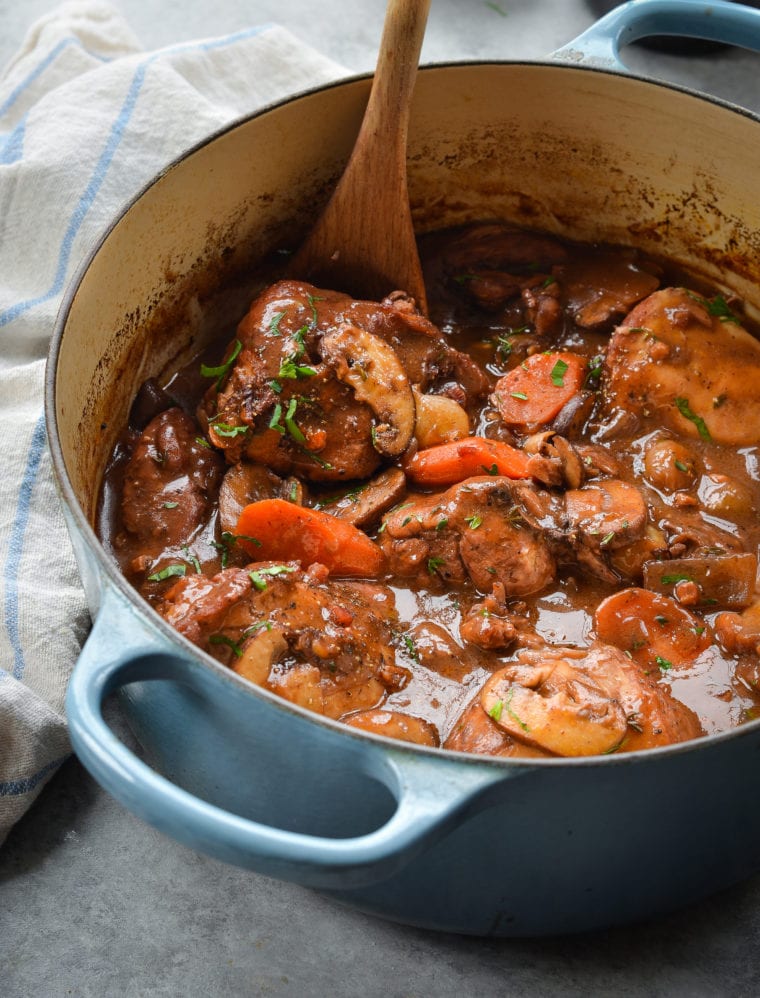
Coq au vin (literally “chicken in wine”) is a classic French stew from the Burgundy region, made with chicken slowly braised in red wine with mushrooms, onions, and pancetta until tender, with a rich, silky sauce. Traditional coq au vin recipes usually call for a whole cut-up chicken, but I use bone-in thighs because they stay especially juicy and tender during braising.
There are a few steps involved, but none of them is difficult, and each one earns its keep—from browning the chicken and mushrooms to reducing the wine and finishing the sauce with beurre manié (a paste of softened butter and flour). It’s a wonderful weekend cooking project and, like my French beef stew, even better made a day ahead. Serve it over buttered egg noodles or with crusty bread for soaking up the sauce.
“Oh my goodness, this was off-the-charts good…We are living in Paris now and I have to say this is better than any other coq au vin we’ve eaten locally. Merci beaucoup!”
What You’ll Need To Make Coq au Vin
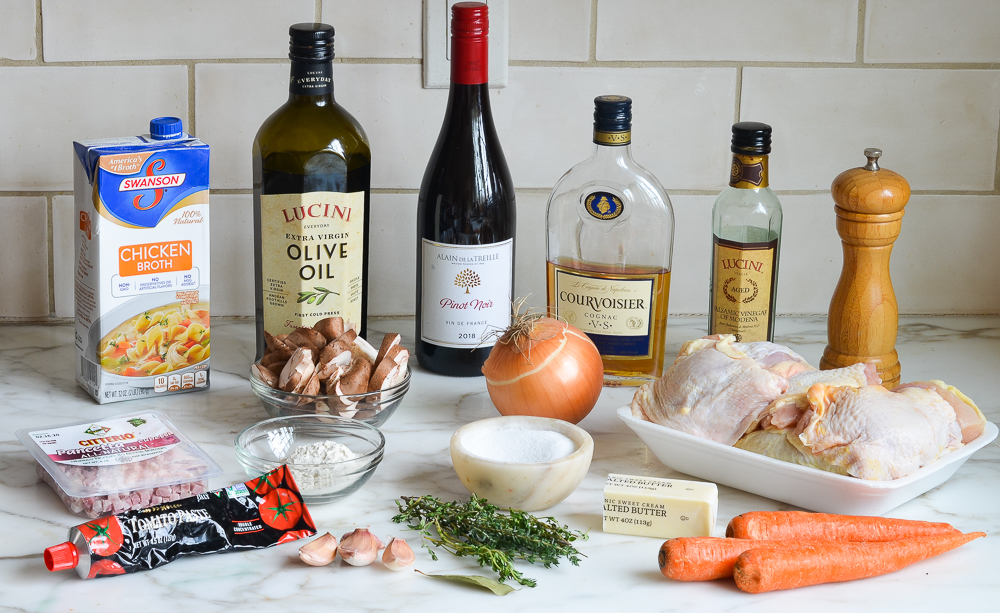
- Chicken thighs: I use bone-in, skin-on thighs rather than a whole cut-up chicken. They stay juicy and tender during braising, and the skin adds flavor and protects the meat as it cooks.
- Pancetta: Adds savory, porky flavor. It’s readily available at the deli counter or pre-cut and packaged in the refrigerated gourmet foods section.
- Onion, garlic & carrots: Form the aromatic and vegetable base of the stew, adding sweetness and depth.
- Red wine & Cognac: Pinot Noir, or Burgundy, is the traditional choice for coq au vin, but any dry, medium-bodied red will work. No need to use anything pricey; just something you’d enjoy drinking—no supermarket cooking wine! The Cognac adds another layer of flavor and helps loosen the browned bits from the bottom of the pot.
- Chicken broth: Adds savory depth to the braising liquid without overpowering the wine.
- Tomato paste & balsamic vinegar: Tomato paste adds richness and body to the sauce, while a splash of balsamic adds brightness.
- Thyme & bay leaf: Give the stew its classic herbal notes.
- Cremini mushrooms: Browning them separately concentrates their flavor and helps them brown rather than steam in the stew.
- Butter & flour: Mashed together to make a beurre manié, which is stirred into the sauce at the end to thicken it and give it a silky consistency.
- Jump to the printable recipe for precise measurements
How To Make Coq Au Vin
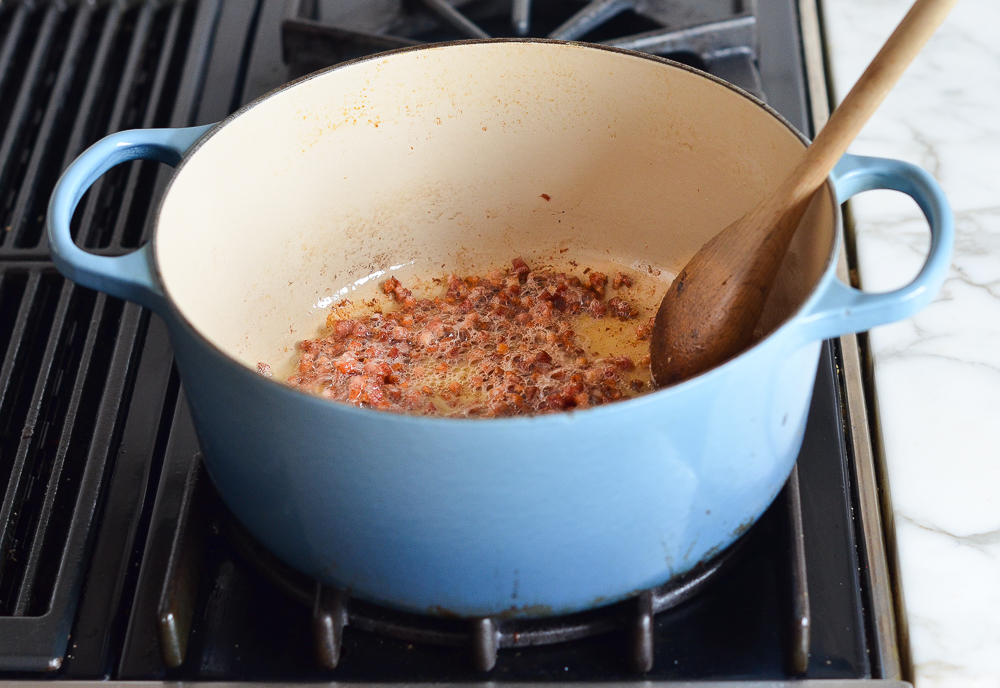
Brown the pancetta and chicken: Cook the pancetta until crisp, then transfer it to a plate, leaving the rendered fat in the pot. Brown the chicken, skin-side down, until deeply golden. Don’t rush this step—the browned bits that build up on the bottom of the pot will add loads of flavor to the sauce.
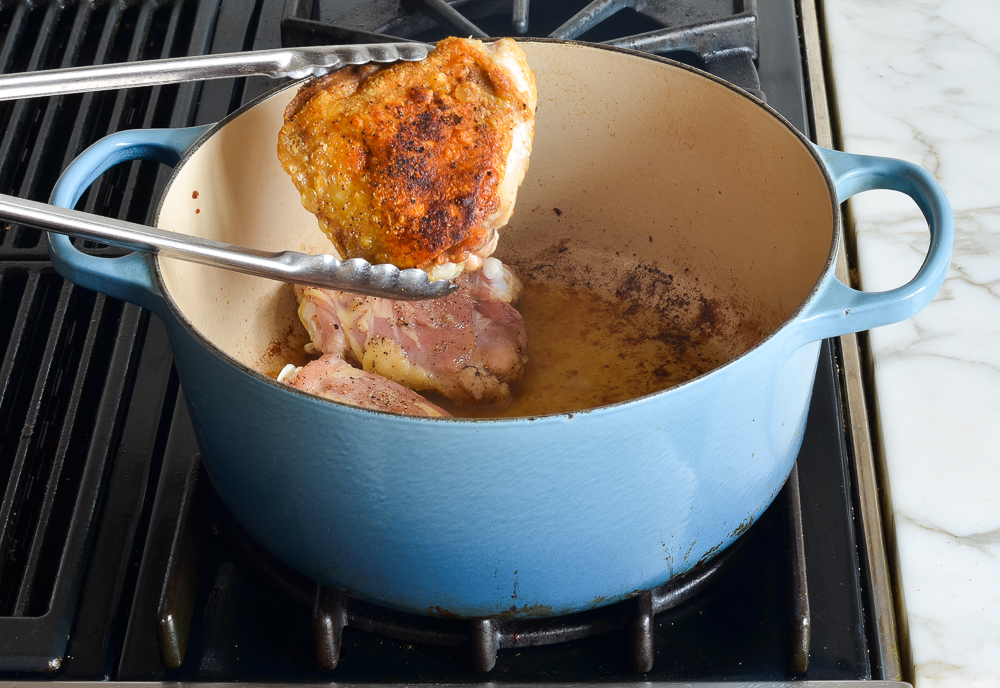
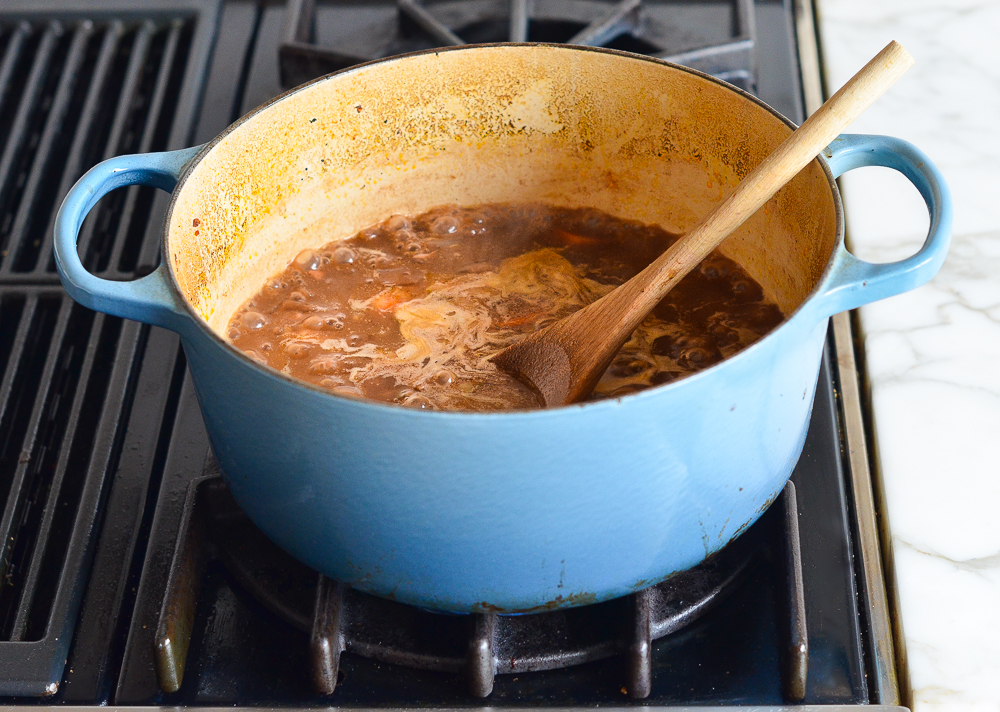
Build and reduce the red wine sauce: Cook the onion until softened and lightly golden, then add the garlic. Deglaze with the Cognac, scraping up the flavorful browned bits from the bottom of the pot. Add the wine, broth, tomato paste, balsamic vinegar, and seasonings, then simmer uncovered to concentrate the wine and deepen the flavor of the sauce.
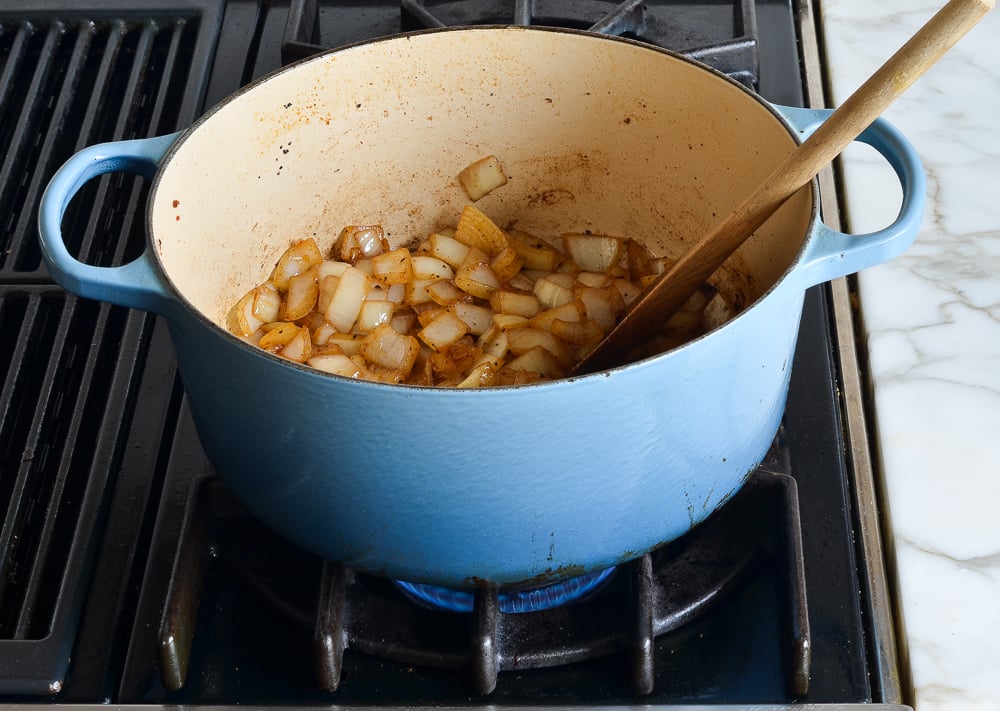
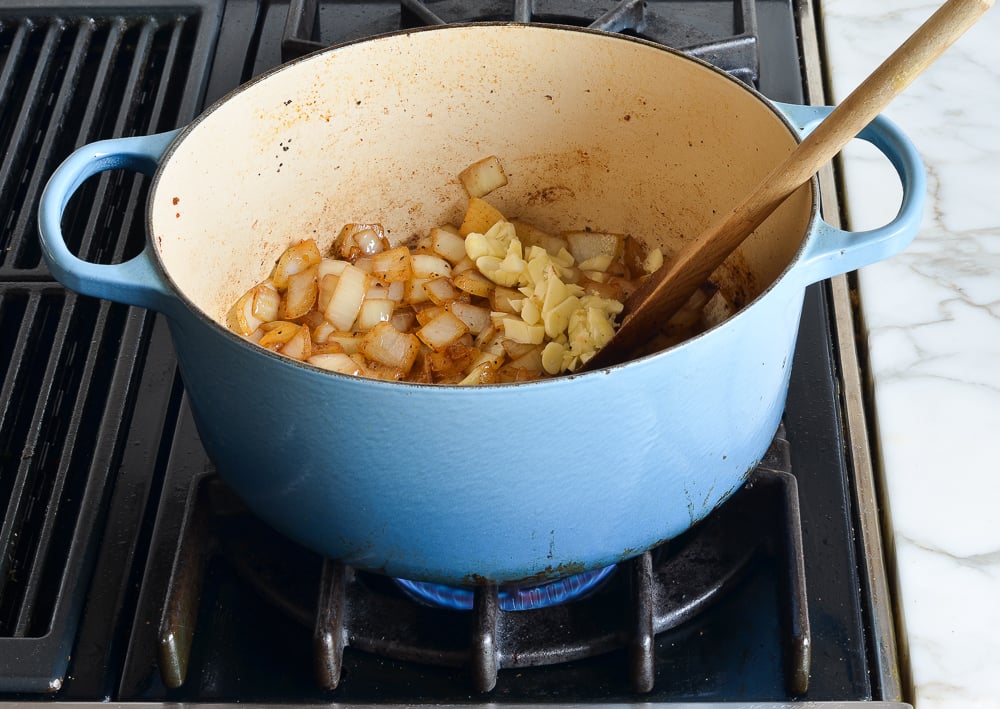
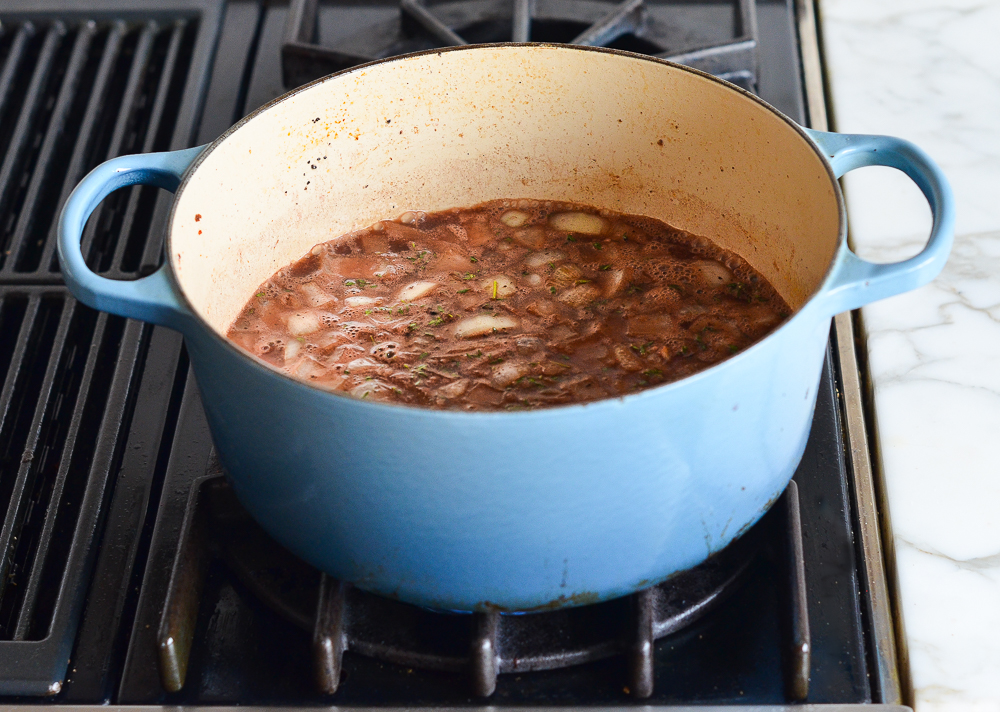
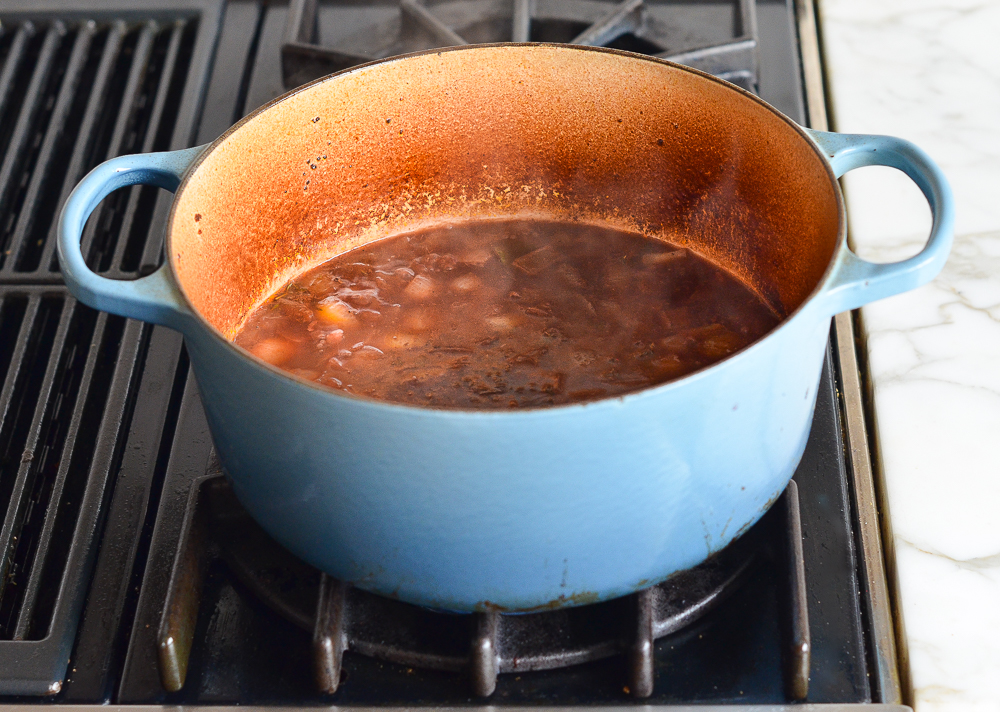
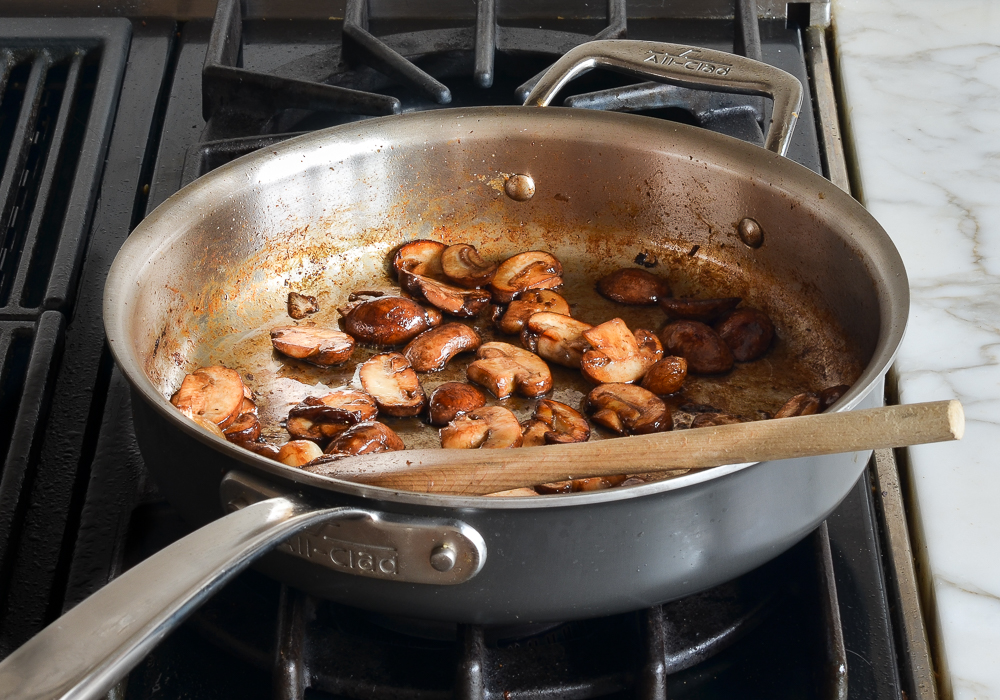
Braise the chicken and brown the mushrooms: Return the chicken to the pot along with the carrots and braise until tender. Meanwhile, sauté the mushrooms separately until nicely browned and their liquid has evaporated. Cooking them separately allows them to brown and develop flavor rather than simply simmer in the stew.
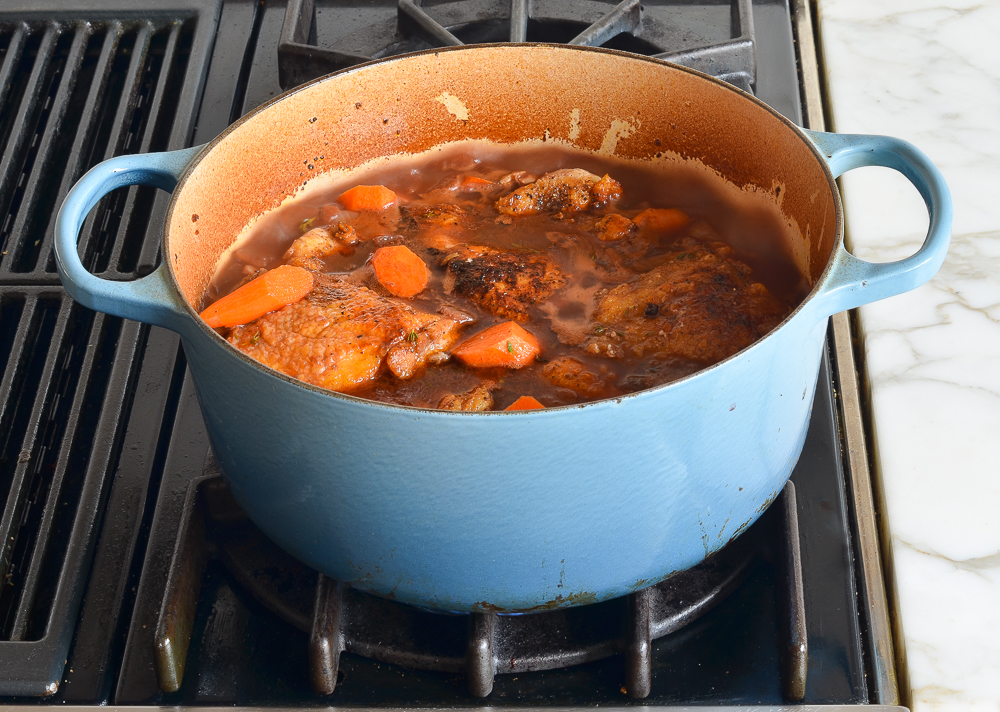
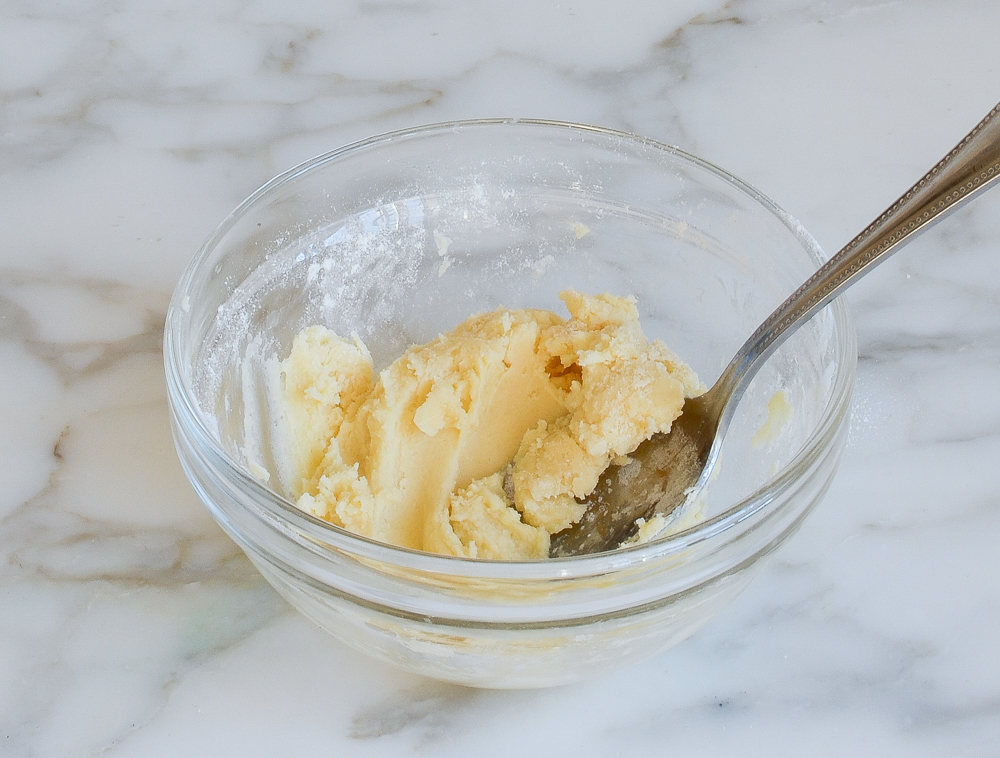
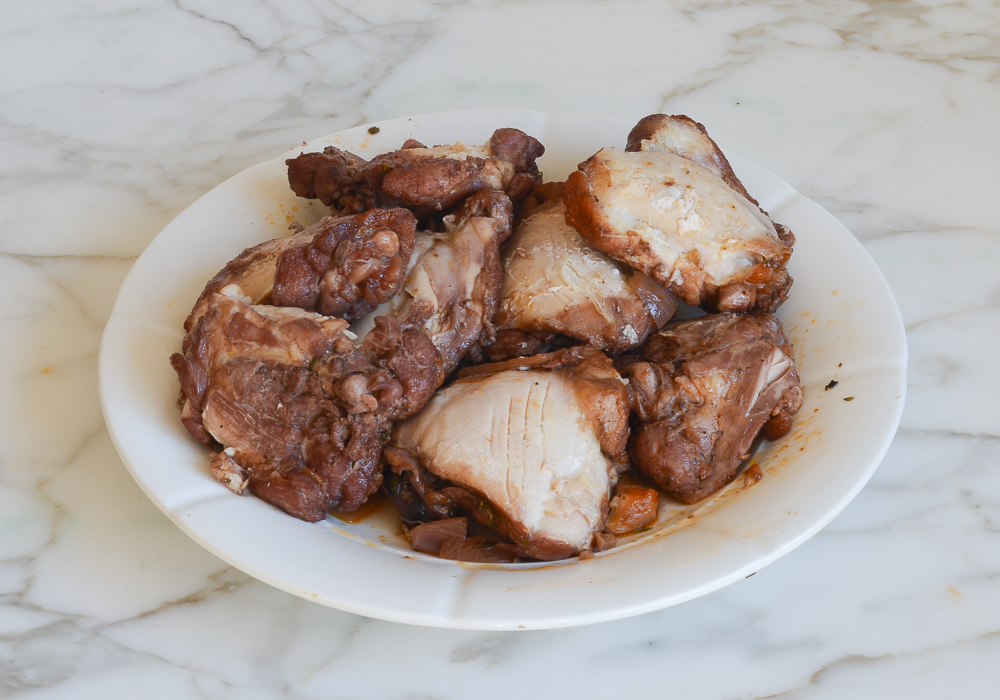
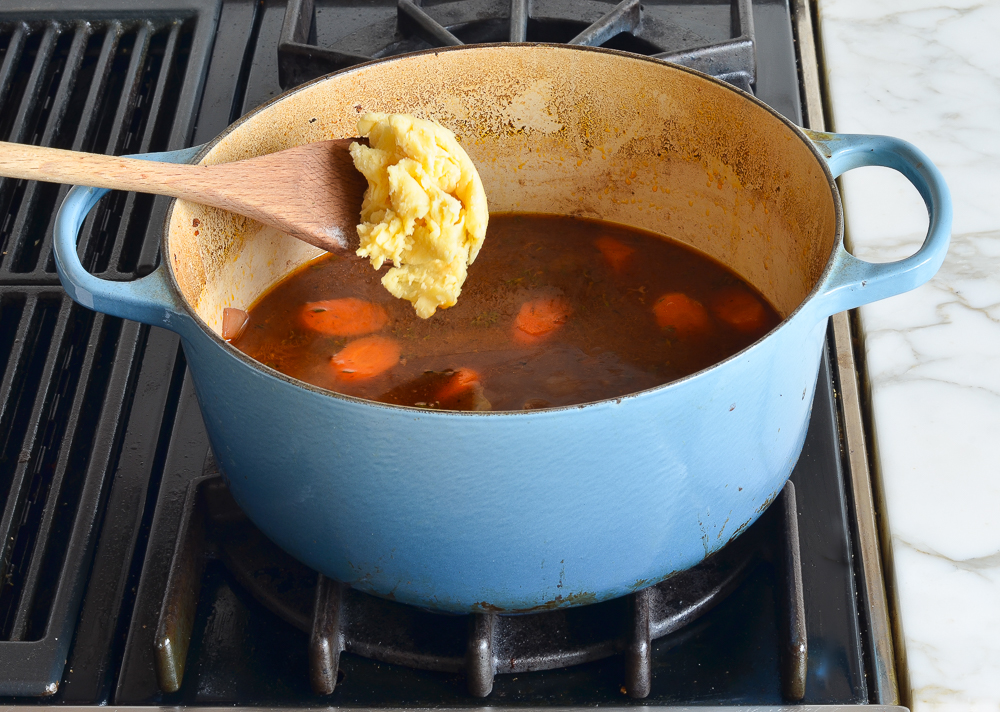
Finish the sauce: Mash the softened butter and flour together to make a smooth beurre manié. Transfer the chicken to a plate and remove the skin—it adds flavor and helps keep the meat moist during braising, but becomes soft as it cooks and is best discarded. Stir the beurre manié into the simmering liquid until the sauce is silky and lightly thickened.
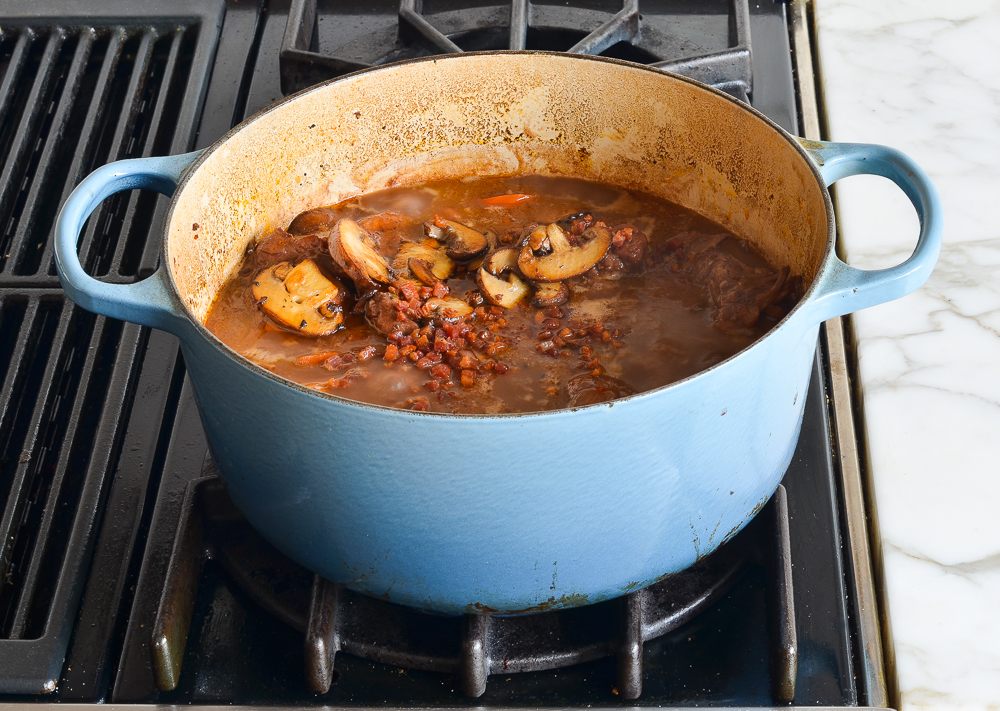
Bring it all together: Return the chicken to the pot and simmer briefly in the finished sauce. Stir in the browned mushrooms and crisp pancetta just before serving. Serve right away, or cool and refrigerate until you’re ready to enjoy it. The stew also freezes beautifully.
Video Tutorial
More Classic French Recipes You May Like


Coq au Vin
Ingredients
- 3 tablespoons olive oil, divided
- 4 oz diced pancetta (or bacon)
- 8 bone-in, skin-on chicken thighs (about 4 lbs/1.8 kg), trimmed of excess skin (see note)
- Salt
- Freshly ground black pepper
- 1 large yellow onion, roughly chopped
- 4 cloves garlic, roughly chopped
- ¼ cup Cognac
- 2½ cups red wine, preferably Burgundy or Pinot Noir
- 2½ cups chicken broth
- 1½ tablespoons tomato paste
- 2 teaspoons balsamic vinegar
- 1½ teaspoons sugar
- 1 tablespoon fresh thyme leaves (or 1 teaspoon dried)
- 1 bay leaf
- 3 large carrots, peeled and cut into ½-in (13-mm) chunks on the bias
- 8 ounces sliced cremini mushrooms
- 4 tablespoons unsalted butter, softened
- 4 tablespoons all-purpose flour
Instructions
- Heat 1 tablespoon of the oil in a large (5-qt/4.8-L) Dutch oven or heavy-bottomed pot over medium heat. Add the pancetta and cook until the fat has rendered and the pancetta is crispy, 5 to 8 minutes. Using a slotted spoon, transfer the pancetta to a paper-towel-lined plate, leaving the fat in the pan.
- Season the chicken all over with 2 teaspoons salt and ½ teaspoon pepper. Increase the heat to medium-high and brown half of the chicken in a single layer, skin side down, until golden and crispy, about 5 minutes (brown on the skin side only). Using tongs, transfer the chicken to a plate; set aside. Repeat with the remaining chicken. Pour off all but about 2 tablespoons of the fat.
- Return the pot to the stove and reduce the heat to medium-low. Add the onions to the pot and cook, stirring occasionally, until the onions are softened and just starting to brown, 3 to 5 minutes. Add the garlic and cook, stirring constantly, until fragrant, about 1 minute more. Add the Cognac and cook, stirring to scrape the brown bits from the bottom of the pan, until the Cognac has evaporated. Add the wine, chicken broth, tomato paste, balsamic vinegar, sugar, thyme, bay leaf, and ½ teaspoon salt. Bring to a boil, then reduce the heat to medium and gently boil, uncovered, for 15 minutes.
- Add the chicken and any accumulated juices from the plate back to the pot, along with the carrots. Bring to a simmer, then cover and cook over low heat for 30 minutes, or until the chicken and carrots are cooked through.
- While the chicken cooks, heat the remaining 2 tablespoons of oil in a large skillet over medium heat. Add the mushrooms and ¼ teaspoon salt and cook, stirring frequently, until the mushrooms are golden brown, about 5 minutes. Set aside.
- Also while the chicken cooks: In a small bowl, mash the softened butter and flour to make a smooth paste. Set aside.
- Using a slotted spoon, transfer the cooked chicken to a plate.
- Increase the heat in the Dutch oven/pot to medium and stir in three-quarters of the flour and butter paste. Gently boil until the sauce is thickened, 5 to 7 minutes; add the remaining paste if you’d like the sauce a little thicker. Fish out and discard the bay leaf.
- Using a fork and knife, pull the skin off of the chicken and discard.
- Add the chicken and any accumulated juices back to the pot and simmer, uncovered, for about 10 minutes. Right before serving, stir in the browned mushrooms and pancetta. Taste and adjust seasoning, if necessary, then serve.
Notes
- Sometimes chicken thighs have excess skin and/or fat. Before cooking, using kitchen shears, trim any skin that extends farther than the edges of the chicken thigh, and snip off any excess fat.
- Make-Ahead/Freezing Instructions: Prepare the stew as directed, then cool it to room temperature before refrigerating for up to 2 days. Reheat over medium-low heat on the stovetop before serving. (For best results, store the sautéed mushrooms and crispy pancetta in separate containers in the refrigerator and add before serving.) If you want to freeze the dish, transfer it to an airtight container once it has cooled and for up to 3 months. Before serving, defrost the stew in the refrigerator for 24 hours and then reheat on the stovetop over medium-low heat until hot.
Pair with
Nutrition Information
This website is written and produced for informational purposes only. I am not a certified nutritionist and the nutritional data on this site has not been evaluated or approved by a nutritionist or the Food and Drug Administration. Nutritional information is offered as a courtesy and should not be construed as a guarantee. The data is calculated through an online nutritional calculator, Edamam.com. Although I do my best to provide accurate nutritional information, these figures should be considered estimates only. Varying factors such as product types or brands purchased, natural fluctuations in fresh produce, and the way ingredients are processed change the effective nutritional information in any given recipe. Furthermore, different online calculators provide different results depending on their own nutrition fact sources and algorithms. To obtain the most accurate nutritional information in a given recipe, you should calculate the nutritional information with the actual ingredients used in your recipe, using your preferred nutrition calculator.
The absolute best I have ever made and guests agreed. I followed the recipe exactly and would not change a thing. I have made MANY of your recipes and they never disappoint. Your thoroughness and attention to detail are greatly appreciated. I wish other sources would do the same. By the way, I have been a serious cook for 40 years and don’t give praise easily!
So glad you enjoyed it!! 🙂
finally making for company…want to time it with the noodles
how long to reheat and at what temperature…med or med/low
thanks Jenn
Hi Carol, It’s hard to give an exact number, but I would guess that it might take about 10 minutes over medium heat. You could also reheat it 30 minutes before you plan to serve, then take it off the heat, cover, and keep warm. Simply place the stew back on the heat for a few minutes while you boil the noodles so it’s hot to serve. Hope everyone enjoys!
Excited to try this recipe this weekend! Jenn, is there a type of cognac you recommend, or could I use brandy that’s already in my liquor cabinet as substitute?
Hi Maggie, I use Courvoisier but if you already have brandy in your liquor cabinet, I’d just use that. Hope you enjoy!
Hi Jenn,
I just made this for Valentine’s dinner for my husband. I have made a lot of your recipes and they have always been a hit but this was the best bar none he said! I used bacon because it’s what I had and used whisky instead of cognac to deglaze the pan. Outstanding! Spectacular! Best ever! Thanks so much for making me look so good!
If anyone is interested, I very successfully substituted grape juice (type with no sugar added) and a dash of red wine vinegar in place of the red wine. Also omitted the cognac. And I halved the recipe. So I basically butchered the recipe as listed and it’s probably not authentic AT ALL but it still tasted AMAZING. Can’t wait til I’m no longer pregnant and will be back to cooking with (and drinking!) wine! I’m sure when the coq is actually paired with the vin it’ll taste even more fab!
Thanks for weighing in Suzanne — I’m sure readers will appreciate hearing how your non-alcoholic version worked out!
I made this recipe, and my wife and I both thought the finished dish was terrific. We did let it rest overnight in the fridge, and re-heated it for our lunch. Great! By the way, I love how your recipes begin with an extended “lesson” with step-by-step photos, with tips and comments along the way, before you get to the “short-form” recipe. Very helpful, very clever!
Would 4.5 qt. Le creuset work for this recipe?
It should fit, but you won’t have much room to spare! 🙂
I did try the 4.5 pan and there really wasn’t enough room so I ended up transferring it to a bigger pan in the end. It turned out to be delicious. Another great recipe from your repertoire!
Sorry to have misled you a bit, but glad it turned out well. Thanks for reporting back in as your follow up will be helpful for other readers!
Did you serve with brown rice in promo photo ? I 💕your beef stew with red wine as so worth the time & effort as all you recipes are perfection !
So glad you like the recipes, Patricia! No, I’ve never served this over brown rice, but you could. I really like it best over buttered egg noodles or mashed potatoes. 🙂
Hello! Sorry to ask such a sill question but I am new to cooking, do I go to the liquor store to purchase the Cognac or is there a cooking Cognac in the stores. Same question as the red wine. Can that be purchased in a store. I don’t drink so I know nothing about them. Thanks!
**silly**
Hi Kim, You can get the wine at a grocery store (if it’s available where you live) but you’ll probably have to go to the liquor store for the cognac.
This recipe is easy, and the result is absolutely delicious! I made it for the first time a couple of weeks ago, and I’m making it again tomorrow. Luckily, a friend had been given me a bottle of French cognac for Christmas, so I didn’t need to go and buy one. My company raved about this coq au vin! I used gluten free flour, and the sauce was perfect.